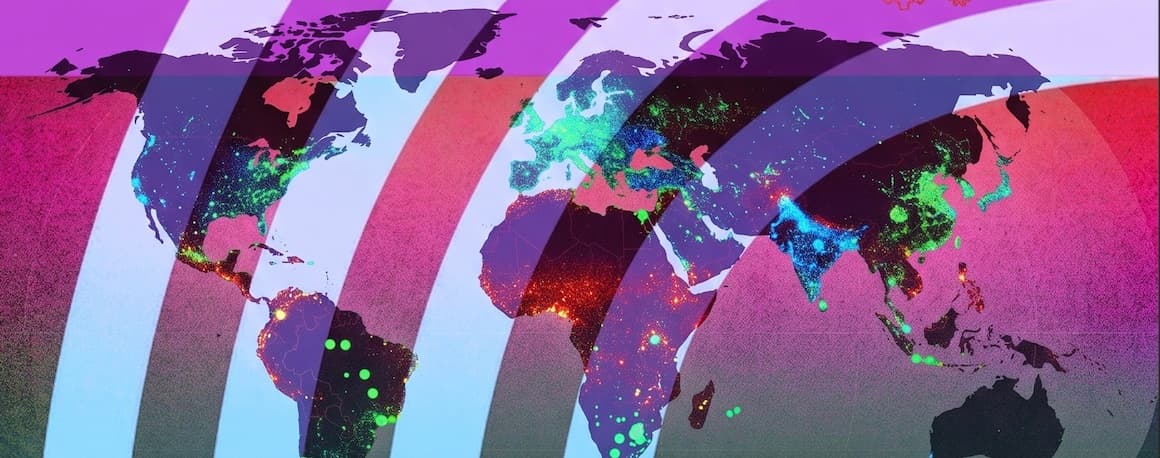
National AI exposure
Click a country to inspect it. Use +/− or scroll to zoom, drag to pan, and double-click or Reset to restore the view.
Loading interactive map…
Policymaker Executive Summary
Frontier AI systems, large-scale models and tools with rapidly expanding capabilities, are diffusing into labour markets, public services, and everyday life faster than most Global South governments can govern them in the public interest. The Global South accounts for roughly 88% of humanity and 90% of people under 25, yet investment, compute, and frontier model production remain concentrated in the Global North; Africa, home to about 18% of the world’s population, receives less than 2% of global AI investment.[24]Link to footnote While 128 of 135 governments assessed by the Global Index on Responsible AI (GIRAI) show some commitment to responsible AI, average governance scores remain around 35/100, and evidence of implementation exists in only about 55% of cases with active frameworks, falling to roughly 45% in the Global South. This governance gap risks deepening existing digital inequalities in connectivity, affordability, skills, and language, while creating new forms of fragmentation through AI’s uneven impacts on work, remittances, and children’s rights.[2]Link to footnote[3]Link to footnote[24]Link to footnote
Internet access has grown at remarkable speed, but digital opportunity remains deeply unequal. Europe and the Americas now exceed 80–89% internet penetration, while Asia averages about 61% and Africa around 40%, with much lower effective use where speeds are slow and costs high. Generative AI reached about 53% population-level adoption within three years, faster than the PC or the internet, but adoption correlates strongly with GDP per capita, while U.S. private AI investment alone ($285.9B in 2025) was more than 23× China’s private figure ($12.4B). Frontier deployments thus concentrate in high-income economies with dense white-collar employment and near-universal connectivity, leaving many Global South countries less exposed to productivity gains but highly exposed to downstream harms such as labour-market polarisation, remittance volatility, and opaque public-sector automation.[3]Link to footnote[5]Link to footnote[6]Link to footnote[7]Link to footnote[25]Link to footnote
Key risks across four policy levers
-
Labour market dynamics. Frontier AI unevenly exposes national economies: the most exposed countries are up to 2.6× more exposed than the least exposed, and exposure is largely explained by white-collar employment shares. High-income regions in North America and Europe & Central Asia are at least 50% more exposed than Sub-Saharan Africa, raising risks that productivity gains, task recomposition, and new AI-complementary jobs will accrue to already advantaged economies. AI Index evidence shows productivity gains of 14–26% in customer support and software development alongside entry-level employment declines in high-adoption markets, channels that can transmit demand shocks to migrant-sending Global South economies through offshoring and remittance corridors. Algorithmic management and AI-mediated recruitment can further entrench discrimination and surveillance.[6]Link to footnote[8]Link to footnote[9]Link to footnote[25]Link to footnote
-
Remittance flows and migration. The jagged-economy framework highlights a novel indirect exposure channel: remittances. Frontier AI could compress labour demand in remittance-reliant sectors (call centres, back-office services) and shift recruitment towards AI-enhanced skill-recognition systems that may underrate migrants’ capabilities due to language and cultural bias, threatening household incomes and foreign-exchange reserves in many Global South states. Because generative-AI adoption tracks GDP per capita, destination-country productivity gains and entry-level displacement can intensify remittance volatility for lower-income origin economies even when those economies themselves remain lightly “exposed” on domestic occupational metrics.[5]Link to footnote[6]Link to footnote[25]Link to footnote
-
Language representation and inclusion. GIRAI finds that governments increasingly recognise the need for local-language AI but rarely require developers to deliver it; only a minority have binding frameworks on cultural and linguistic diversity (47 countries). Without enforceable obligations and public investment in data and compute for low-resource languages, frontier AI may lock Global South populations into English-centric or major-language ecosystems.[2]Link to footnote[10]Link to footnote
-
Children’s rights protection. AI literacy is one of the strongest-performing indicators globally, 71 countries have some framework and 106 show related activities, yet only 55 countries have frameworks addressing children’s rights in AI, and just 27 show implementation. Emerging recognition in places such as The Gambia and Bangladesh remains the exception rather than the norm.[2]Link to footnote[11]Link to footnote[12]Link to footnote
Figure 1, GIRAI conceptual framework
Loading GIRAI figure…
Figure 2 & A2, GIRAI scores by region
Loading GIRAI figure…
Regional patterns that shape the Global South divide
GIRAI scores underscore a two-tier governance landscape: Europe and Northern America average above 54, while Africa scores around 22 and Asia & Oceania about 33, with Global South regions generally below 40.[2]Link to footnote AI Use in Public Service is the weakest dimension globally, only 18% of countries require disclosure of government algorithmic systems and 26% ensure fair and accountable public procurement of AI.[2]Link to footnote
Global South countries led much of the expansion in framework coverage between GIRAI editions, increasing covered policy areas by about 83%, but 78% of their frameworks are non-binding, compared with 42% in the Global North.[2]Link to footnote Binding, multi-indicator AI laws in Brazil and Peru show that structured implementation covering labour protections, environmental impact, procurement, and disclosure is feasible in Global South contexts.[2]Link to footnote
Southeast Asia exemplifies these broader patterns: urban areas in major cities reach around 90% internet penetration and 80% high-speed access, while rural areas average about 55% penetration and 30% high-speed access, with lower digital and AI literacy. High-income ASEAN members lead in 5G and AI adoption; lower-income peers struggle with affordability and skills, increasing the risk of AI-driven divergence within and between countries.[1]Link to footnote[13]Link to footnote[14]Link to footnote
The AI Index underscores the same asymmetry at global scale: generative-AI adoption is already mass-market in some high-income hubs (Singapore 61%, UAE 64%) while the United States ranks only 24th at 28.3%, and private capital remains extreme, U.S. private AI investment dwarfs China’s private figure even as Africa captures less than 2% of global AI investment. More than half of newly adopted national AI strategies now come from developing countries entering the policy landscape for the first time, but strategy adoption is not the same as enforceable governance or shared compute.[24]Link to footnote[25]Link to footnote
Private AI investment concentration, 2025
Global AI capital stack, 2025
Southeast Asia case study, GIRAI dimension profiles
| Metric | Singapore | Vietnam | Indonesia | Thailand | Philippines | Cambodia | Myanmar |
|---|---|---|---|---|---|---|---|
| Inclusion & diversity | 59.1 | 34.0 | 39.6 | 21.9 | 29.4 | 27.7 | 9.2 |
| Ethics & sustainability | 43.5 | 31.0 | 34.7 | 33.4 | 33.7 | 16.3 | 8.6 |
| Labour & skills | 39.2 | 52.3 | 50.7 | 49.7 | 30.7 | 28.2 | 17.5 |
| Trust & safety | 55.2 | 41.8 | 43.8 | 37.0 | 37.4 | 22.0 | 15.9 |
| Public-service AI | 29.1 | 48.8 | 25.3 | 43.1 | 33.7 | 26.3 | 9.8 |
Priority recommendations
Recommendations below preserve ASEAN-specific levers while aligning with Maheshwari’s equity–ethics–ecology horizons: short term to 2027, medium term to 2030, and long term to 2035.[24]Link to footnote
Short term (to 2027)
Equity · readiness · state capacity
Medium term (to 2030)
Ethics · local languages · interoperable trust
Long term (to 2035)
Ecology · sovereignty · shared rule-making
Immediate (to 2027). Mandate registers of algorithmic systems used in welfare, justice, tax, and migration; jointly assess frontier AI exposure in labour and remittance-reliant sectors; establish cross-sector child-digital-rights task forces; deploy AI literacy campaigns in rural and marginalised communities; and use GIRAI / readiness indices to redesign institutional architecture around open tech, DPI, and enforceable oversight rather than voluntary checklists alone.[2]Link to footnote[5]Link to footnote[6]Link to footnote[11]Link to footnote[24]Link to footnote
Medium term (to 2030). Create or strengthen independent AI and data-protection authorities; embed labour protections and reskilling in national AI strategies; negotiate regional language-inclusion compacts with frontier developers under ASEAN and peer frameworks; institutionalise children’s rights, including impact assessments for systems affecting children; and scale South–South cooperation on shared infrastructure and audit capacity.[2]Link to footnote[10]Link to footnote[11]Link to footnote[20]Link to footnote[21]Link to footnote[24]Link to footnote
Long term (to 2035). Invest in symmetric rural broadband and digital public infrastructure, guided by World Bank and ITU regional metrics; strengthen South–South coalitions on shared procurement and open AI building blocks; establish binding floors on unacceptable-risk AI uses; and secure proportionate Global South representation in transnational rule-making while treating ecological sustainability as a core design constraint.[2]Link to footnote[6]Link to footnote[15]Link to footnote[22]Link to footnote[23]Link to footnote[24]Link to footnote
Frontier AI’s impacts on the digital divide in the Global South will be shaped less by inherent technological properties than by policy choices and institutional capacity. The next phase of responsible AI must be judged by enforceable protections, practical oversight, and inclusive design, not by the proliferation of non-binding frameworks.
AI Index 2026: models, compute, climate, and responsible AI
Stanford’s AI Index 2026 situates Global South governance gaps against the physical and institutional stack behind frontier systems, who builds notable models, where data centres and chips concentrate, how energy and emissions scale, and whether responsible-AI practice keeps pace with capability.[25]Link to footnote
Top takeaways for Global South policy
Capability and concentration
Infrastructure, ecology, and RAI lag
Investment, adoption, and labour
Sovereignty, education, and trust
1.1 Notable AI models, affiliation, sector, release, compute
Notable AI models by national affiliation, 2025
Notable AI models by sector, 2025 (% of total)
Industry concentration and falling disclosure matter for Global South rule-makers: capability benchmarks are widely reported, while training-code openness collapsed (81 of 102 notable 2025 models released without training code). Reported parameters have flattened near ~1 trillion for three years even as independently estimated training compute continues to rise, and synthetic data has not yet replaced real pre-training data at scale, though data pruning and post-training techniques can close gaps (e.g. OLMo 3.1 Think 32B matching larger models on several benchmarks).[25]Link to footnote
1.2–1.3 Compute, infrastructure, and data centres
Data centres by country, 2025
Beyond GPUs, the stack depends on HBM (SK Hynix, Samsung, Micron), high-bandwidth networking, and foundry capacity, reinforcing Maheshwari’s ecology point that Global South economies often host extraction and deployment sites while capturing limited value from the compute layer.[24]Link to footnote[25]Link to footnote
1.4 Energy and environmental impact
Estimated training carbon emissions, select models
Model energy consumption for medium-length prompts (2025)
Model carbon emissions for medium-length prompts (2025)
Data center electricity consumption by region, 2024 vs 2030
GPU computation cost index, 2006–24
For Global South climate and energy policy, the asymmetry is sharp: falling unit compute costs accelerate Northern scale-up, while absolute power, water, and emissions concentrate where grids and cooling are already stressed, and where many countries still lack universal electricity access.[24]Link to footnote[25]Link to footnote
Research output and responsible AI lag
AI publications in CS worldwide, 2013–24
AI publications in CS by geographic share, 2024
Documented AI incidents (AIID), 2024–25
Taken together, Chapter 1 of the AI Index and its responsible-AI findings reinforce the equity–ethics–ecology frame: industry-dominated model production, U.S.-centric data-centre geography, falling unit GPU costs with rising absolute energy demand, and RAI practice that trails capability, all while publication volume diversifies geographically faster than frontier compute or enforceable governance.[24]Link to footnote[25]Link to footnote
Technical executive summary
This report applies the GIRAI-2026 methodological framework and Global Survey dataset to analyse frontier AI’s impact on the digital divide across the Global South, with Southeast Asia as a detailed regional case study. GIRAI’s second edition organises 38 indicators across five dimensions, Inclusion and Diversity; Ethics and Sustainability; Labour and Skills; Trust and Safety; and AI Use in Public Service, assessed through three pillars (AI Policy 0.6, CSO Engagement 0.1, Enabling Conditions 0.3), plus a transversal Unacceptable Risk AI Systems (URAI) penalty.[2]Link to footnote[16]Link to footnote
Complementary global measurement layers include Murugan et al.’s jagged exposure and remittance metrics; Stanford’s AI Index 2026 series on investment, adoption, national strategies, skills, incidents, and public opinion; and Maheshwari’s equity–ethics–ecology policy framing for Global South participation in AI governance. These layers are not substitutes for GIRAI’s evidence coding, they situate governance gaps in capital concentration, mass adoption, and power asymmetries.[6]Link to footnote[24]Link to footnote[25]Link to footnote
Methodological approach
Primary data covers 135 countries between 1 November 2023 and 30 September 2025. Country researchers document legal instruments, policies, strategies, guidelines, programmes, and initiatives using original-language sources, subject to multi-layer review.[16]Link to footnote Secondary Enabling Conditions indicators draw on Varieties of Democracy, Worldwide Governance Indicators, World Justice Project labour rights, ITU cybersecurity, Digital Development Compass skills measures, and Mobile Connectivity Index inclusion metrics.[2]Link to footnote[16]Link to footnote
Frontier AI exposure analysis overlays Murugan et al.’s jagged global economy framework, national AI exposure metrics across 141 countries combining occupation-level scores with employment data, plus an indirect remittance channel. This framework is not part of GIRAI’s scoring but interprets distributional risks alongside governance gaps.[6]Link to footnote
GIRAI maps relevant indicators to each policy lever: Gender Equality, Children’s Rights, Cultural and Linguistic Diversity, Labour Protections, Reskilling and Upskilling, AI Literacy, Safety and Security, Access to Redress and Remedy, AI-facilitated Misinformation and Violence, Public Sector Skills Development, Public Disclosure of Government Algorithmic Systems, Public Procurement, and Government Mechanisms for CSO Inclusion.[2]Link to footnote
Figure 3, Top 10 implementation activities for active frameworks
Loading GIRAI figure…
Figure 4, AI Policy frameworks implementation ratio by region
Loading GIRAI figure…
Figure 5, Framework coverage and implementation ratio by indicator
Loading GIRAI figure…
Analytical limitations
- Coverage and selection. GIRAI’s 135-country sample may under-represent fragile or conflict-affected states; jagged exposure metrics require harmonised occupational data and exclude some microstates.[6]Link to footnote[16]Link to footnote
- Transparency gaps. Countries with weak publication practices may have under-documented governance measures; URAI evidence depends on investigative reporting and civil-society monitoring, especially constrained in authoritarian or conflict-affected contexts such as Myanmar.[4]Link to footnote[16]Link to footnote
- Temporal lag. The study window coincides with rapid frontier-AI advances; connectivity, employment, and remittance statistics often lag one to two years.[6]Link to footnote[16]Link to footnote
- Cultural and linguistic validity. English survey instruments coding national-language evidence can bias culturally dense concepts such as children’s rights or redress.[16]Link to footnote
- Informal undercounting. ISCO-based exposure and remittance matrices understate informal agriculture, street work, care, and micro-enterprise that dominate many Global South labour markets.[6]Link to footnote
Figure 6, Average AI Policy indicators covered (2024 vs 2026)
Loading GIRAI figure…
Figure 7, Growth in Safety & Security framework coverage by region
Loading GIRAI figure…
Figure 8, Recorded cases of unacceptable-risk AI systems (URAI)
Loading GIRAI figure…
Conceptualising frontier AI and the digital divide
Beyond access: multi-level digital inequality
The digital divide in the Global South is no longer only about access. First-level divides concern physical access to devices and networks; second-level divides involve skills, kinds of use, and quality of connectivity; third-level divides capture differential capacity to translate digital engagement into favourable offline outcomes such as income, education, or health.[17]Link to footnote Gender, rurality, disability, and linguistic minority status often interact to produce compounded exclusions.[17]Link to footnote
Frontier AI introduces additional layers:
- Capability jaggedness. Frontier systems excel at certain cognitive and linguistic tasks while remaining weak in others; economies differ sharply in how labour is allocated across those tasks, so productivity gains and displacement risks cluster by occupational structure and institutional capacity.[6]Link to footnote
- Infrastructure and compute asymmetry. High-income countries dominate high-end compute, specialised talent, and proprietary datasets, while many Global South states depend on external platforms, limiting their ability to shape AI to local needs or enforce governance conditions. Maheshwari frames this as a post-colonial “rule-taker” pattern: the Global South supplies training data, deployment sites, and critical minerals while capturing limited economic value and bearing high ecological costs.[15]Link to footnote[6]Link to footnote[24]Link to footnote
- Platformisation and data extraction. Deployment often occurs through global platforms embedded in public and private workflows, making national governance harder and transforming local data into value elsewhere.[2]Link to footnote
- Context misfit. Models and vehicles designed for high-bandwidth, English-dominant, energy-abundant settings underperform where networks are constrained, scripts and dialects are under-represented, and electricity access gaps remain large, about 750 million people lack electricity globally, with 80% of that gap in Sub-Saharan Africa.[24]Link to footnote
Global South governance gaps that shape the jagged divide
The charts below locate Global South deficits within GIRAI’s global distributions: soft-law expansion without enforcement, weak public-sector disclosure, thin children’s-rights and language frameworks, and North–South gaps on transparency and labour protections. Maheshwari’s reading complements GIRAI: most prominent frameworks remain voluntary or path-dependent on Global North legal systems; imported rules (GDPR-style privacy laws; EU AI Act extraterritorial effects) can spur legislation while straining limited state capacity and domestic SMEs. More than half of newly adopted national AI strategies now originate in developing countries, and AI sovereignty is rising as an organising principle, yet model production and private capital remain concentrated in the United States and China, and documented AI incidents rose to 362 in 2025 (from 233 in 2024), underscoring that strategy adoption is outrunning responsible-AI capacity.[2]Link to footnote[24]Link to footnote[25]Link to footnote
Documented AI incidents, 2024–2025
Selected AI governance frameworks, status and motivation
| Status | Primary motivation | |
|---|---|---|
| EU AI ActEuropean Commission · 2021 | Enforced since 2024 | Protect fundamental rights via risk-based regulation |
| OECD AI PrinciplesOECD · 2019 | Voluntary | Promote innovation and human-centric AI |
| UNESCO Recommendation on the Ethics of AIUNESCO · 2022 | Voluntary | Safeguard human rights and cultural diversity |
| America’s AI Action PlanU.S. OSTP · 2025 | Advisory | Achieve and maintain global AI leadership |
| UK pro-innovation AI regulation paperDSIT · 2023 | Under development | Proportionate, sectoral risk management |
| Singapore Model AI Governance FrameworkIMDA · 2019 (updated 2023) | Voluntary guidance | Practical ethical and governance implementation |
Figure 9, Framework coverage of AI-facilitated misinformation & violence by region
Loading GIRAI figure…
Figure 10, Framework coverage across AI Policy indicators
Loading GIRAI figure…
Figure 11, Framework coverage of gender equality by region
Loading GIRAI figure…
Figure 12, AI literacy vs children’s rights: frameworks and initiatives
Loading GIRAI figure…
Figure 13, Framework coverage gap (Global North vs Global South)
Loading GIRAI figure…
Figure 14, Active frameworks vs government-led initiatives
Loading GIRAI figure…
Figure 15, Labour protections vs reskilling: frameworks and initiatives
Loading GIRAI figure…
Figure 16, Regional variation in framework coverage across AI Policy indicators
Loading GIRAI figure…
Policy levers: labour, remittances, language, children’s rights
Labour market dynamics
AI literacy is among the strongest-performing GIRAI indicators, yet labour protections related to AI, safeguards against surveillance, discrimination, and weakened collective rights, have frameworks in only a minority of countries, with implementation evidence in about 12% of Global South states.[2]Link to footnote Frontier AI is projected to reduce the share of routine tasks rather than eliminate work wholesale; without proactive reskilling, recomposition may leave low-skill and informal workers behind.[6]Link to footnote
AI Index labour evidence sharpens the remittance channel: measured productivity gains of 14–26% in customer support and software development coincide with entry-level employment declines in high-adoption markets (U.S. developers aged 22–25 saw employment fall nearly 20% from 2024). When destination-country BPO, back-office, and junior software demand softens, migrant-sending Global South economies can face remittance and skills-recognition shocks even if their domestic white-collar exposure scores remain low.[6]Link to footnote[25]Link to footnote Skills formation is uneven but not static, AI engineering skills are accelerating fastest in the UAE, Chile, and South Africa, yet public and expert views of labour impacts diverge sharply (23% vs 73% expecting positive job effects), complicating the politics of protective regulation.[25]Link to footnote
AI skills share of job postings, 2025 (selected economies)
Remittance flows and migration
Remittances constitute significant shares of GDP in many low- and lower-middle-income countries. AI-induced shifts in labour demand in high-income destinations could destabilise these flows, while AI in migration management, biometric verification, fraud detection, skill matching, can improve efficiency but entrench discrimination if opaque or poorly calibrated.[5]Link to footnote[6]Link to footnote[8]Link to footnote
Language representation and inclusion
Only a minority of countries have frameworks explicitly addressing cultural and linguistic diversity in AI, and most do not require developers to deliver language coverage or performance guarantees. Frontier models perform best in English and a handful of major languages, contributing to exclusion in AI-mediated education, health, and public services. Under-representation of Indian and African languages, scripts, dialects, and accents is a structural bias; English-pivoted machine translation can lose contextual meaning in Nigerian and other languages.[2]Link to footnote[10]Link to footnote[24]Link to footnote
Frugal, context-aware approaches show a different path: India’s Bhashini uses English as a pivot across 22 official languages with far fewer pairwise models than a full mesh would require; open-source and open-weight development is also redistributing participation, with rest-of-world GitHub contributions now outpacing Europe and supporting more linguistically diverse models and benchmarks. Governance that rewards open tech and DPI can therefore reduce vendor lock-in while expanding language coverage, if paired with enforceable inclusion duties rather than voluntary statements alone.[24]Link to footnote[25]Link to footnote
Language-pair models: full mesh vs Bhashini pivot
Children’s rights protection
GIRAI shows a significant gap between preparing future generations for AI and protecting them from AI-related harms: literacy frameworks outpace child-specific protections on profiling, targeted content, and harmful design. Few countries have dedicated policies; UNICEF guidance and bright spots such as The Gambia’s protection framework remain under-adopted. Documented AI incidents continue to rise globally, reinforcing the need for child-specific safeguards rather than literacy programmes alone.[2]Link to footnote[11]Link to footnote[12]Link to footnote[25]Link to footnote
Regional case study: Southeast Asia in the Global South context
Southeast Asia illustrates many Global South dynamics: rapid growth in internet access and digital services alongside persistent rural, income, and gender gaps. Affordability and quality issues widen the divide; high-income economies such as Singapore lead in 5G and innovation, while lower-income peers face infrastructure deficits and digital-literacy gaps.[1]Link to footnote[13]Link to footnote[14]Link to footnote
ASEAN exposure snapshot from the Jagged release
| Exposure | Rank | White-collar % | Jagged pattern | |
|---|---|---|---|---|
| Singapore | 0.368 | #2 | 73.8% | High exposure + high adoption + stronger governance |
| Philippines | 0.252 | #76 | 21.5% | BPO + remittance dual vulnerability |
| Thailand | 0.250 | #78 | 18.1% | Displacement pressure in ASEAN labour studies |
| Indonesia | 0.242 | #85 | 15.3% | Archipelagic divide + migrant remittance dependence |
| Myanmar | 0.229 | #103 | 8.2% | Low transparency; constrained GIRAI evidence |
| Vietnam | 0.225 | #108 | 13.5% | Rising adoption; AI law post-dates GIRAI window |
| Cambodia | 0.221 | #113 | 10.2% | Connectivity + governance thinness |
Singapore
Singapore combines near-universal connectivity, advanced 5G, and robust digital public infrastructure with high national AI exposure (0.368, rank #2 of 141). Frontier AI is likely to recompose high-skill service work and public-sector functions rather than displace a large informal sector, but risks include increased surveillance, algorithmic discrimination in migration and work permits, and language exclusion for non-English speakers. High exposure and governance capacity position Singapore as a potential regional hub, and raise questions about cross-border effects on migrant-sending neighbours.[2]Link to footnote[6]Link to footnote
Indonesia
Indonesia’s dual pattern, national exposure around 0.24 with white-collar shares near 15%, combines urban–rural and archipelagic divides with remittance dependence. Frontier AI may automate service tasks in offshored call centres and BPO, affect overseas Indonesian workers, and expand AI-enabled agricultural and health platforms that require language localisation and connectivity.[6]Link to footnote[9]Link to footnote[13]Link to footnote
Vietnam
Vietnam’s exposure around 0.225 (white-collar share near 13.5%) coincides with growing manufacturing and services and a standalone risk-based AI law effective March 2026, post-dating GIRAI’s September 2025 study window.[19]Link to footnote Remittance-accounted exposure indicates Vietnamese migrants often work in higher-exposure occupations abroad; UNICEF partnerships on child cyber safety are a regional reference point.[6]Link to footnote[12]Link to footnote[18]Link to footnote
Philippines
The Philippines’ exposure around 0.252 (white-collar share near 21.5%) sits atop a large BPO sector and remittance receipts near US$40 billion. Automation of call-centre tasks abroad and AI-enhanced skill matching can both improve efficiency and introduce bias; language technologies favour Filipino/English over Cebuano, Ilocano, and other regional languages.[5]Link to footnote[6]Link to footnote[10]Link to footnote
Cambodia and Myanmar
Cambodia (exposure ~0.221, white-collar 10%) and Myanmar (0.229, ~8%) embody the lower tail of both digital inclusion and AI governance distributions. Connectivity, especially fixed broadband, is limited; GIRAI scores are among the lowest in Asia & Oceania; binding AI-specific laws are rare; and civic-space limits constrain evidence of unacceptable-risk AI deployments.[2]Link to footnote[4]Link to footnote[6]Link to footnote
When remittances raise national AI exposure
- Colour = remittance share of GDP
- Size = remittance share of GDP
Loading interactive figure…
Singapore
Indonesia
Vietnam
Philippines
Cambodia & Myanmar
Implementation funnels and full country matrix
From adopted frameworks (L1) to operational provisions (L2) and government-led initiatives (L3), Global South regions show both lower starting coverage and steeper attrition, the policy-to-practice gap that soft-law expansion alone cannot close.
Figure A16, From policy frameworks to implementation (global)
Loading GIRAI figure…
Figure A17, Implementation funnel by dimension
| Metric | L1, Adopted framework | L2, Operational provision | L3, Government initiative |
|---|---|---|---|
| Inclusion & diversity | 39.0% | 31.0% | 17.0% |
| Ethics & sustainability | 48.0% | 34.0% | 15.0% |
| Labour & skills | 45.0% | 40.0% | 29.0% |
| Trust & safety | 45.0% | 35.0% | 18.0% |
| Public-service AI | 31.0% | 23.0% | 14.0% |
Figure A18, Implementation funnel by region
| Metric | L1, Adopted framework | L2, Operational provision | L3, Government initiative |
|---|---|---|---|
| Northern America | 82.0% | 68.0% | 53.0% |
| Europe | 71.0% | 66.0% | 42.0% |
| S. & C. America | 44.0% | 37.0% | 16.0% |
| Asia & Oceania | 41.0% | 23.0% | 13.0% |
| Middle East | 49.0% | 26.0% | 11.0% |
| Caribbean | 13.0% | 13.0% | 5.0% |
| Africa | 21.0% | 16.0% | 7.0% |
Figure A1a, Country profiles from the full GIRAI matrix
| Metric | Norway | Brazil | Singapore | India | Nigeria | Philippines | South Sudan |
|---|---|---|---|---|---|---|---|
| Inclusion & diversity | 76.1 | 72.0 | 59.1 | 54.2 | 52.1 | 29.4 | 0.2 |
| Ethics & sustainability | 75.1 | 63.4 | 43.5 | 39.6 | 49.6 | 33.7 | 1.1 |
| Labour & skills | 75.2 | 76.3 | 39.2 | 40.6 | 40.9 | 30.7 | 5.4 |
| Trust & safety | 75.8 | 61.5 | 55.2 | 56.9 | 63.5 | 37.4 | 5.1 |
| Public-service AI | 74.2 | 67.1 | 29.1 | 33.3 | 23.7 | 33.7 | 8.4 |
Figure A1, Country-level GIRAI 2026 score index
Loading GIRAI figure…
Methods appendix: Jagged visualization suite
Compositional exposure correlates with observed generative-AI usage in vendor telemetry, but telemetry is biased toward digitally connected, English-capable, formal-sector users. White-collar share remains the dominant linear association (R² ≈ 0.91); remittance corridors transmit indirect shocks to lower-exposure origin economies.[6]Link to footnote
What predicts national AI exposure?
- Countries
- Trend fit
Loading interactive figure…
Anthropic Claude usage vs national exposure
- Countries
- Trend fit
Loading interactive figure…
By aligning GIRAI’s evidence-based matrix with the jagged-economy framework, AI Index investment–adoption–policy measurement, and Maheshwari’s equity–ethics–ecology agenda, illustrated through Southeast Asia’s labour, remittance, language, and children’s-rights levers, this report aims to support policymakers, regional organisations, multilaterals, private-sector actors, and civil society in shifting frontier AI governance from commitment to enforceable protections and inclusive institutions.[2]Link to footnote[6]Link to footnote[15]Link to footnote[24]Link to footnote[25]Link to footnote
- 1.Kearney, “Building an Internet for the future of Southeast Asia”: https://www.kearney.com/service/digital-analytics/article/-/insights/building-an-internet-for-the-future-of-southeast-asia
- 2.Global Index on Responsible AI (GIRAI) 2026, 2nd Edition, Adams et al., Global Center on AI Governance. Data: GIRAI Public Repository rankings, survey, and editions comparison. Canonical site: https://www.global-index.ai/
- 3.ITU, Facts and Figures 2025, internet use and ICT affordability: https://www.itu.int/itu-d/reports/statistics/2025/10/15/ff25-internet-use/
- 4.World Bank, Myanmar Infrastructure Monitoring, internet restrictions and investment impacts: https://documents1.worldbank.org/curated/en/099045004062227744/pdf/P1775400ae5d010a40990c01a972a73c2fc.pdf
- 5.World Bank remittances press release (26 June 2024) and People Move blog on 2024 LMIC remittance flows: https://www.worldbank.org/en/news/press-release/2024/06/26/remittances-slowed-in-2023-expected-to-grow-faster-in-2024
- 6.Murugan, Aguirre, Nagaraj & Bommasani (2026), The Jagged Global Economy. Interactive release: https://jagged-global-economy.github.io/ (CC BY 4.0). Paper: https://arxiv.org/html/2607.05404v1
- 7.Brookings, “Fixing the global digital divide and digital access gap”: https://www.brookings.edu/articles/fixing-the-global-digital-divide-and-digital-access-gap/
- 8.ICMPD policy brief, “Digitalisation and labour migration” (2023): https://www.icmpd.org/file/download/61771/file/2023-07-06_Policy_Brief_July_EN_pages.pdf
- 9.“Artificial Intelligence and Labour Markets in Southeast Asia: An Empirical Examination,” Asian Economic Letters: https://a-e-l.scholasticahq.com/article/132415-artificial-intelligence-and-labour-markets-in-southeast-asia-an-empirical-examination
- 10.Carnegie Endowment, “Speaking in Code”; Tech for Good Institute, “Mind the Language Gap”: https://carnegieendowment.org/research/2025/01/speaking-in-code-contextualizing-large-language-models-in-southeast-asia ; https://techforgoodinstitute.org/insights/perspectives/mind-the-language-gap-building-an-inclusive-ai-future-for-southeast-asia/
- 11.UNICEF Innocenti, Policy guidance on AI and children: https://www.unicef.org/innocenti/reports/policy-guidance-ai-children
- 12.DigWatch / UNICEF Vietnam warnings on AI risks to child online safety: https://dig.watch/updates/unicef-child-online-safety-vietnam
- 13.ERIA, “An Inclusive Digital Economy in the ASEAN Region”: https://www.eria.org/uploads/An-Inclusive-Digital-Economy-in-the-ASEAN-Region.pdf
- 14.OECD, “Extending Broadband Connectivity in Southeast Asia”: https://www.oecd.org/content/dam/oecd/en/publications/reports/2023/12/extending-broadband-connectivity-in-southeast-asia_74819f28/b8920f6d-en.pdf
- 15.LSE Africa at LSE, “South-South cooperation can power the Global South’s digital future”: https://blogs.lse.ac.uk/africaatlse/2024/11/08/south-south-cooperation-can-power-the-global-souths-digital-future/
- 16.GIRAI 2026 methodology (pillar weights, study period, quality assurance): https://www.global-index.ai/methodology
- 17.Heeks, “Digital inequality beyond the digital divide” (2022): https://www.tandfonline.com/doi/full/10.1080/02681102.2022.2068492
- 18.OpenGov Asia, “Vietnam, UNICEF Collaborate on AI and Child Cyber Safety”: https://opengovasia.com/vietnam-unicef-collaborate-on-ai-and-child-cyber-safety/
- 19.OneTrust, “Vietnam AI Law Explained” (law effective 1 March 2026): https://www.onetrust.com/blog/vietnam-ai-law-explained-what-the-new-rules-mean-for-ai-development-and-deployment/
- 20.ASEAN Guide on AI Governance and Ethics (2024): https://asean.org/wp-content/uploads/2024/02/ASEAN-Guide-on-AI-Governance-and-Ethics_beautified_201223_v2.pdf
- 21.Expanded ASEAN Guide on AI Governance and Ethics, Generative AI (2025): https://asean.org/wp-content/uploads/2025/01/Expanded-ASEAN-Guide-on-AI-Governance-and-Ethics-Generative-AI.pdf
- 22.World Bank, Digital Progress and Trends Report 2025: https://openknowledge.worldbank.org/bitstreams/706410ab-0833-41f0-96e8-51bb34383d8e/download
- 23.ITU, State of digital development and trends in Asia and the Pacific: https://www.itu.int/dms_pub/itu-d/opb/ind/D-IND-SDDT_ASP-2025-PDF-E.pdf
- 24.Maheshwari, Deepak. “AI’s Global South Pivot: Equity, Ethics and Ecology.” Centre for International Governance Innovation, Policy Brief No. 225, February 2026.
- 25.Sajadieh, Sha; Fattorini, Loredana; Perrault, Raymond; Gil, Yolanda; et al. “The AI Index 2026 Annual Report.” AI Index Steering Committee, Institute for Human-Centered AI, Stanford University, April 2026. https://doi.org/10.48550/arXiv.2606.15708 (CC BY-ND 4.0).