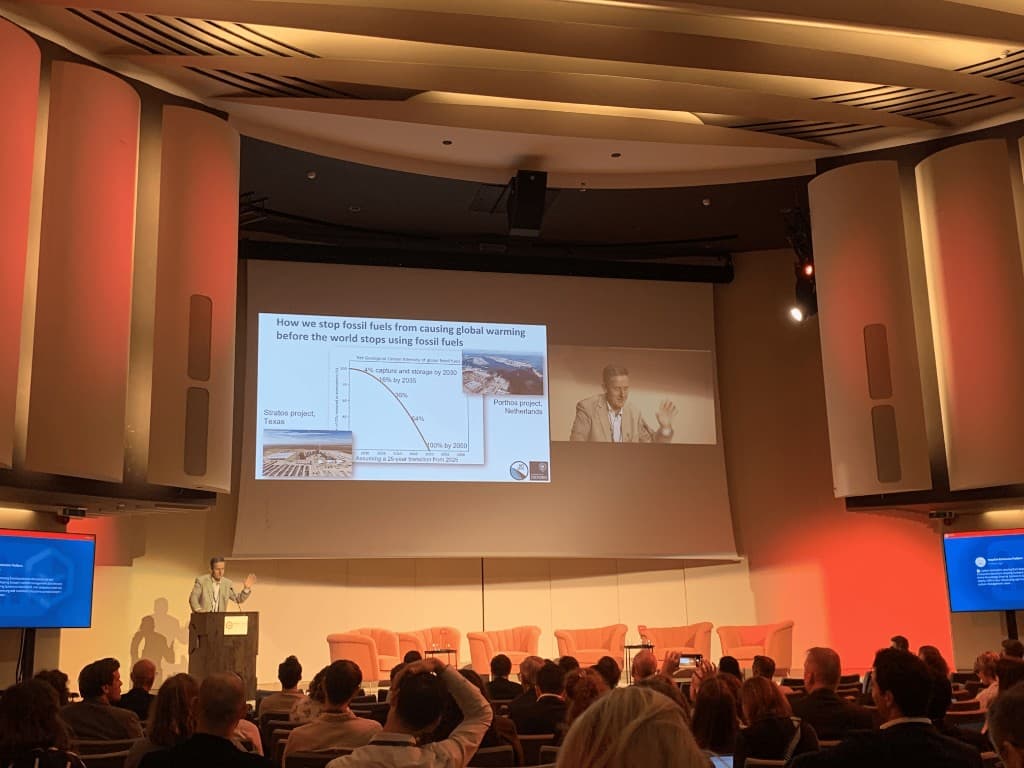
Mix Brussels, June 2026
We were onsite at the Negative Emissions Summit 2026[3]Link to footnote on 4 June 2026 at Mix Brussels, the largest European policy convening on permanent carbon dioxide removal, hosted by the Negative Emissions Platform (NEP) and running alongside the European Commission's CRCF stakeholder days and the Invest in Carbon Removals networking programme at the Sofitel Brussels Europe.[29]Link to footnote[31]Link to footnote From the opening plenary through compliance-market roundtables, industry showcases, and Oliver Geden's closing fireside chat with Sebastian Manhart, the floor delivered a single diagnosis: the voluntary corporate green premium has plateaued, and the future of engineered carbon removal depends on compliance market integration, sovereign-backed demand, and regulatory enforcement, not narrative alone.[1]Link to footnote[2]Link to footnote
The summit theme, "Carbon removals: Europe's new economic superpower", framed CDR as industrial infrastructure rather than philanthropic offsetting.[4]Link to footnote Yet cross-referencing summit claims against legislative texts, registry data, and peer-reviewed baselines (including the 3rd Edition of the State of Carbon Removal, published 2 June 2026) reveals a persistent gap between ambition and execution: novel permanent removals remain roughly 0.1% of global removal volume, NZIA Article 23 storage targets face a projected ~50% shortfall, and startup cost projections below $50–100/tonne for direct air capture strain thermodynamic credibility.[6]Link to footnote[19]Link to footnote[15]Link to footnote This briefing synthesises what we heard in Brussels with dual-source investigative verification, integrating session-level thematic analysis with commercial underwriting scrutiny into a unified assessment for policymakers, investors, and C-suite sustainability leaders.
Executive summary
The carbon dioxide removal industry is undergoing a structural transition from voluntary, premium-priced corporate procurement toward compliance-driven regulatory frameworks. At Negative Emissions Summit 2026, EU policymakers (DG CLIMA), sovereign storage advocates (Norway), the world's largest corporate buyer (Microsoft), registry platforms (Puro.earth), and venture-backed developers (Climeworks, Neustark, Obrist) converged on a shared policy agenda: integrate CRCF-certified permanent removals into the EU Emissions Trading System, deploy sovereign Contracts for Difference, and enforce NZIA Article 23 storage obligations on oil and gas producers.[3]Link to footnote[7]Link to footnote[8]Link to footnote
Four findings dominate the synthesized assessment:
- The compliance pivot is now the central commercial thesis. Voluntary demand alone cannot finance high-cost permanent pathways. Industry lobbyists and regulators alike treated mid-2026 EU ETS review proposals as the decisive demand signal.[5]Link to footnote[7]Link to footnote
- Storage infrastructure execution lags statutory ambition. NZIA mandates 50 Mt/yr CO₂ injection capacity by 2030, but permitting timelines (~8 years) and pipeline analysis suggest the unrisked European CCS storage pipeline may miss the target by nearly half unless Member State penalties bite by the June 2026 deadline.[6]Link to footnote[8]Link to footnote
- Scientific integrity conflicts with corporate standard-setting. Professor Myles Allen's "like-for-like" ledger, fossil emissions neutralised only by permanent geological or mineral storage, directly contradicts SBTi Corporate Net-Zero Standard v2.0 (released 11 June 2026), which permits up to 59% of residual footprints to be neutralised via short-term biological sinks.[7]Link to footnote[11]Link to footnote
- Commercial cost claims require thermodynamic discounting. Operational DACCS runs $600–1,000/t; biochar CORCs trade $150–250/t; startup projections below $50/t assume electricity below $15/MWh and negligible capital depreciation, conditions incompatible with commercial scale.[13]Link to footnote[19]Link to footnote[15]Link to footnote
Problem statement: from gigatonne rhetoric to megatonne delivery
Europe's CDR policy architecture has matured faster than its physical delivery stack. The CRCF's first delegated regulation on permanent removals entered force 7 May 2026, certifying DACCS, BioCCS, and biochar carbon removal under QU.A.L.ITY criteria.[7]Link to footnote The EU registry is scheduled for 2028; until then, fragmented private registries (Puro.earth, Carbonfuture) carry verification burden.[4]Link to footnote Meanwhile, global novel CDR must grow at roughly 40% annually, a trajectory comparable to early solar PV, to reach Paris-aligned mid-century targets.[19]Link to footnote[33]Link to footnote
The summit's unstated tension was mitigation deterrence: whether removal promises delay gross emissions cuts. Allen and Geden anchored the scientific counter-position, reductions and removals must be structurally separated in post-2030 climate frameworks, with distinct Member State targets for gross reductions, LULUCF sinks, and permanent removals.[21]Link to footnote[30]Link to footnote Commercial developers, conversely, lobbied for ETS integration and public procurement to close a projected capacity gap before compliance markets scale in the 2030s.[3]Link to footnote[5]Link to footnote Both reports agree: without near-term sovereign demand, first-mover projects face a financing cliff.
CDR market positioning: voluntary premium vs compliance integration
Methodology: dual verification protocol
This white paper integrates two independent research streams. Report A applied investigative journalism standards and venture-capital underwriting logic, cross-examining summit claims against statutory texts, thermodynamic baselines, registry transactions, and acoustic/transcript records (including The CDR Policy Scoop live at Mix Brussels).[1]Link to footnote[21]Link to footnote Report B structured findings thematically across six summit blocks, scientific keynotes, policy roundtables, industry showcases, industrial integration workshops, capital mobilisation networking, and geopolitics, with primary-source alignment to DG CLIMA filings and EIB stakeholder submissions.[2]Link to footnote[22]Link to footnote
Where the reports converge, findings are presented as unified synthesis. Where they diverge, precedence follows evidence hierarchy: peer-reviewed literature and legislative text supersede corporate marketing; registry-verified delivery supersedes announced offtake MOUs; operational cost data supersedes pilot-scale projections. Contradictions resolved in synthesis include: (a) Report B's more optimistic framing of industry "active delivery" is qualified by Report A's feedstock-scaling and verification-cost risks for biochar; (b) Report A's granular conflict-of-interest matrix complements Report B's session-level speaker attribution; (c) both independently calculated thermodynamic minimum work for DAC (~0.13 GJ/t CO₂) and rejected sub-$50/t claims without unrealistic power pricing.[13]Link to footnote[15]Link to footnote
Literature review: the physical carbon budget
Professor Myles Allen's opening keynote established the scientific boundary conditions. Atmospheric warming responds to cumulative emissions, not annual flows, modelled as remaining budget (B_a = B_{total} - \int E(t),dt).[20]Link to footnote With the global economy emitting 40+ Gt CO₂/yr and a remaining 1.5°C budget of roughly 400–500 Gt, overshoot is probable without rapid gross reductions and durable removals for residual hard-to-abate sectors (aviation, shipping, agriculture).[20]Link to footnote
Allen's "like-for-like" rule, fossil carbon neutralised only by permanent geological or mineral sequestration; biogenic emissions offset by biological sinks, became the summit's scientific baseline.[7]Link to footnote[26]Link to footnote The Negative Emissions Platform formally opposed SBTi v2.0's 41% permanent / 59% short-term neutralisation split as lacking physical basis and risking mitigation deterrence.[11]Link to footnote Geden's closing fireside chat reinforced a geopolitical corollary: over 100 countries have net-zero targets, but only Australia and the UK have incorporated novel CDR into NDCs for 2035, a global demand-signalling failure.[15]Link to footnote
Global carbon removal composition (Gt/yr, 2026)
EU policy architecture: three legislative pillars
European CDR governance rests on three interlocking files. Understanding their interaction, and their execution gaps, is prerequisite to any investment or procurement decision.
EU CDR policy architecture, status and summit implications
| Three-pillar framework (synthesized from legislative audit) | ||||
|---|---|---|---|---|
| Legislative file | 2026 status | Certified / obligated pathways | Execution gap identified at summit | |
| CRCF | Carbon Removal Certification Framework | First delegated regulation in force 7 May 2026; EU registry by 2028 | DACCS, BioCCS, BCR (permanent removals) | Private registry fragmentation until 2028; biochar activity period cut to 5 years |
| NZIA Art. 23 | Net-Zero Industry Act, CO₂ storage obligation | 50 Mt/yr injection capacity target by 2030; MS penalties due 30 Jun 2026 | Oil & gas licence holders, geological storage contribution | Pipeline projected ~50% short; ~8-year permitting timelines |
| EU ETS review | Mid-2026 legislative proposal, compliance integration | Public consultations closed early 2026; proposal expected late 2026 | CRCF-certified permanent removals, volume limits debated | Demand volumes, price caps, and eligibility rules remain projections |
Policy roundtables: bridging the capacity gap
Two linked sessions, Who Buys Next? and Compliance Markets: ETS and Sectoral Obligations, featured Christian Holzleitner and Marina García Alonso (DG CLIMA), David B. Frank (Microsoft), Sanne Rosendaal (ING), Antti Vihavainen (Puro.earth), Molly Tinker (Climeworks), and MEP Niels Flemming Hansen.[3]Link to footnote Consensus emerged on:
- Near-term sovereign purchasing and an EU-level Buyers' Club under CRCF to aggregate demand.[3]Link to footnote
- Blended finance via EIB CfDs guaranteeing minimum revenue floors, NEP's EIB submission cites €25–50 billion gross funding required this decade.[22]Link to footnote[27]Link to footnote
- ETS integration with strict volume limits confined to highly durable, CRCF-certified pathways to preserve the ETS decarbonisation signal.[3]Link to footnote[12]Link to footnote
Norwegian Deputy Director General Alexander Engh advocated state-backed offshore storage networks (Northern Lights JV), framing geological access as sovereign infrastructure.[3]Link to footnote[9]Link to footnote Report A notes the structural tension: Norway's revenues remain tied to natural gas production, creating incentive to promote CCS as industrial management of continued extraction.[9]Link to footnote
EU CDR regulatory milestone map (2026–2028)
CRCF permanent removals delegated act
Entered force May 2026
NZIA Art. 23 MS penalties
Deadline 30 Jun 2026
SBTi Net-Zero Standard v2.0
Released 11 Jun 2026, industry opposition
EU ETS integration proposal
Expected late 2026
Unified EU CRCF registry
Scheduled 2028 go-live
Technology landscape: pathways and deployment reality
Summit showcases spanned the full CDR method spectrum. The scientific keynote drew a sharp line between durable engineered removals and reversible biological sinks, afforestation and soil carbon were acknowledged ecologically but excluded as fossil-offset instruments.[3]Link to footnote[30]Link to footnote
CDR pathways discussed at Mix Brussels
Technology maturity, storage mechanism, and summit presenters
Industrial integration: co-location over greenfield
The Industrial Integration panel (UNIDO, Hafslund Celsio, Omya, Neustark; moderated by Reuters' Mike Scott) established that permanent removal scales faster by leveraging existing supply chains.[3]Link to footnote Waste-to-energy CCS utilises waste heat; concrete mineralisation converts demolition aggregate into sequestered building material; ERW improves soil fertility while locking bicarbonate in runoff.[14]Link to footnote[5]Link to footnote Report B emphasises circular business models; Report A adds that mineralisation economics ($100–300/t) depend heavily on lowering soil-sampling verification costs for ERW.[4]Link to footnote
Digital MRV as bankability infrastructure
Industry showcases converged on automated digital MRV (dMRV), end-to-end tracking from feedstock through pyrolysis, transport, and soil or material application.[16]Link to footnote[22]Link to footnote Carbonfuture's Trust Infrastructure for Exomad Green exemplifies the pattern: manual auditing cannot scale to institutional lender requirements.[37]Link to footnote Report B frames dMRV as the bridge from venture capital to project finance; Report A verifies registry cross-checks against Puro.earth and Senken integrity dashboards.[24]Link to footnote[32]Link to footnote
Market economics: costs, volumes, and revenue stacking
The summit exposed a bifurcated cost landscape, operational reality versus startup projections.
Indicative cost per tonne by CDR pathway (USD/t CO₂)
Developers are pivoting from pure credit sales to revenue stacking: biochar projects sell pyrolysis heat to district heating; mineralisation plants charge aggregate tipping fees; Obrist combines graphite credits with e-methanol licensing.[4]Link to footnote[31]Link to footnote Despite a broader cleantech VC slowdown, permanent CDR captured ~3% of climate-tech investment flows in 2025/26; Germany allocated €500M for negative emissions in 2026 plus €150M in 2027.[19]Link to footnote[4]Link to footnote
CDR pathway positioning: durability vs indicative cost
Growth of novel carbon removal pathways and key milestones
Capital mobilisation and the bankability imperative
Adjacent networking at the Sofitel, tied to CRCF stakeholder meetings and the 2026 Invest in CDR European Roadshow (Stockholm, Zurich, London), focused on converting venture-backed pilots into infrastructure-grade cash flows.[31]Link to footnote Chris Sherwood (NEP), Sebastien Dewarrat (ClimeFi), Tito Jankowski (Airminers), Nicholas Chadwick (Mission Zero), and Leila Toplic (Carbonfuture) addressed the absence of standardised underwriting frameworks.[31]Link to footnote
European CDR capital requirements vs committed public flows (€ billion)
The investability checklist that emerged across both reports:
- Long-term offtake contracts with creditworthy counterparties (Microsoft, Supercritical, sovereign buyers).[39]Link to footnote[45]Link to footnote
- Sovereign de-risking via EIB blended finance absorbing green-premium and FOAK technology risk.[22]Link to footnote
- dMRV standardisation enabling lender diligence at transaction speed.[16]Link to footnote[5]Link to footnote
- Revenue stacking reducing sole dependence on carbon credit price volatility.[4]Link to footnote[29]Link to footnote
Geopolitics, Article 6, and sovereign cooperation
Geden's fireside chat with Manhart (The CDR Policy Scoop, recorded live at Mix Brussels) addressed the Paris Agreement Crediting Mechanism (PACM) under Article 6.4, CBAM interaction, and the Group of Negative Emitters (GONE), initiated by Denmark, Finland, and Panama, as a forum for permanent storage network coordination.[10]Link to footnote[15]Link to footnote[35]Link to footnote
The geopolitical synthesis highlights a North–South fracture: industrialised nations face pressure for net-negative emissions compensating historical footprints, while developing economies remain vulnerable to aid fragmentation.[20]Link to footnote[37]Link to footnote High-integrity carbon finance can channel capital southward, Exomad Green's Bolivia operations exemplify delivery in the Global South, but feedstock sustainability at gigatonne scale remains unresolved.[16]Link to footnote[22]Link to footnote
NZIA Article 23 penalty enforcement
Joint call (NEP, Carbon Gap, Cleantech for Europe, Jacques Delors Energy Centre) urging Member States to implement dissuasive penalties for non-compliant oil and gas producers by the June 2026 deadline.
Separate post-2030 national targets
NEP position paper advocating three legally distinct Member State obligations: gross emissions reductions, LULUCF land sinks, and permanent carbon removals.
SBTi v2.0 opposition
NEP Board formal opposition to 59% biological offset allowance and co-claiming restrictions (par. C29.6) in the draft Corporate Net-Zero Standard.
CDR2030 platform milestone
Global stakeholder coalition targeting 100 Mt/yr novel durable removal capacity by 2030, bridging the gap from ~2 Mt baseline to mid-century gigatonne requirements.
Critical evaluation: thermodynamics, greenwashing, and conflicts of interest
Report A's investigative audit supplies the sceptical counterweight to summit optimism. Three cases illustrate the greenwashing risk diagnostic applied across five dimensions (additionality, reversibility, energy intensity, feedstock/land risk, accounting/double-claiming):
Greenwashing risk diagnostic, summit case studies
| Case | Additionality | Reversibility | Energy intensity | Feedstock / land | Accounting | |
|---|---|---|---|---|---|---|
| Sora Fuel electrochemical DAC (<$50/t) | Sora Fuel DAC | Low risk | Low risk | Critical risk | Low risk | Low risk |
| SBTi Net-Zero Standard v2.0 (59% biological) | SBTi v2.0 draft | Medium risk | Critical risk | Low risk | Critical risk | High risk |
| Exomad Green Bolivian biochar (Puro.earth) | Exomad BCR | Low risk | Medium risk | Low risk | High risk | Medium risk |
Thermodynamic floor for direct air capture
Both reports independently derive the Gibbs free energy minimum for separating CO₂ from ambient air (420 ppm). The theoretical minimum is approximately 0.13 GJ/t (36 kWh/t); real electrochemical and thermal systems require 3–10 GJ/t after efficiency losses.[15]Link to footnote[13]Link to footnote Sub-$50/t capture implies continuous zero-carbon power below $15/MWh with zero capital depreciation, a combination that does not exist at commercial scale. Policymakers and investors should treat such projections as sensitivity bounds, not procurement benchmarks.
Conflict-of-interest matrix
Commercial developers (Climeworks, Neustark, Obrist) and registry platforms (Puro.earth) lobbied for ETS integration and public procurement, policies that directly benefit their valuations.[3]Link to footnote[5]Link to footnote Microsoft, the largest corporate buyer, simultaneously faces a 25% emissions increase from AI data centre expansion while opposing strict international co-claiming bans.[39]Link to footnote[40]Link to footnote[11]Link to footnote DG CLIMA officials navigate member-state target fatigue against NGO demands for strict accounting.[5]Link to footnote Transparent attribution does not invalidate policy positions but demands independent MRV and volume-limited compliance integration as safeguards.
Scenario A
Compliance-first (summit consensus)
EU ETS integrates CRCF-certified permanent removals with strict volume caps; sovereign CfDs bridge 2026–2032; NZIA penalties enforce storage access. Novel CDR reaches CDR2030 100 Mt/yr target. High integrity; high cost.
Scenario B
Voluntary-standard drift (SBTi path)
Corporate net-zero dominated by biological sinks (59% allowance). Engineered CDR demand signal weakens; mitigation deterrence risk rises. Lower near-term cost; critical reversibility exposure.
Scenario C
Storage execution failure
NZIA Article 23 penalties not implemented; CCS pipeline misses 2030 target by ~50%. DACCS/BECCS stranded despite certification. Biochar and mineralisation gain relative advantage via distributed storage.
Implications and recommendations
For policymakers
- Implement NZIA Article 23 penalties immediately. Without dissuasive Member State regimes, the 50 Mt/yr storage target is unenforceable, undermining the entire geological removal stack.[8]Link to footnote[44]Link to footnote
- Design ETS integration with separate sub-targets. Permanent removals, land sinks, and gross reductions must not collapse into a single net figure.[21]Link to footnote[30]Link to footnote
- Align SBTi and CRCF durability standards. The June 2026 SBTi v2.0 release contradicts the summit's scientific baseline; EU regulatory influence should push corporate standards toward like-for-like accounting.[11]Link to footnote[7]Link to footnote
- Accelerate unified registry timelines. Private registry fragmentation until 2028 creates double-claiming and liquidity risk.[4]Link to footnote[35]Link to footnote
For investors and corporate buyers
- Underwrite delivered tonnes, not MOUs. Registry-verified retirements (Puro.earth, Carbonfuture) supersede announced offtake headline volumes.[16]Link to footnote[22]Link to footnote
- Apply thermodynamic discount rates to DAC cost models. Stress-test at >$100/t operational and $30–50/MWh power, not pilot-scale assumptions.[15]Link to footnote[13]Link to footnote
- Demand dMRV as a financing condition. End-to-end digital traceability is the difference between venture equity and project debt.[5]Link to footnote[16]Link to footnote
- Structure revenue stacking in term sheets. Projects dependent solely on credit price exposure fail bankability screens articulated by ING and EIB stakeholders.[3]Link to footnote[22]Link to footnote
For technology developers
- Prioritise industrial co-location. Waste heat, existing permits, and circular feedstocks compress time-to-volume relative to greenfield geological storage.[3]Link to footnote[5]Link to footnote
- Publish energy intensity alongside cost curves. Summit credibility requires transparent kWh/t and capex assumptions, not marketing-level $/t targets.[13]Link to footnote[15]Link to footnote
- Plan for biochar feedstock constraints. Current sawmill-residue models do not extrapolate to megatonne scale without land-use risk.[22]Link to footnote[16]Link to footnote
Conclusion
Negative Emissions Summit 2026 marked the moment Europe's CDR conversation shifted from whether permanent removals matter to how compliance architecture, sovereign capital, and storage infrastructure convert certification into gigatonne-scale delivery. What we observed at Mix Brussels was not climate science debate, it was market design under pressure: developers lobbying for ETS access, regulators calibrating volume limits, scientists drawing irreversible lines around biological offsets, and investors demanding bankability proof points.
The synthesized assessment is cautiously constructive but unsparing on execution. Biochar and mineralisation are delivering physical volume today; DACCS and BECCS await storage access and power cost structures that honest engineering acknowledges. SBTi v2.0 risks undermining the integrity framework the CRCF was built to establish. €25–50 billion in public and blended capital is required this decade, an order of magnitude beyond current commitments.
Europe possesses the regulatory scaffolding to lead global permanent removal markets. Whether it becomes an "economic superpower" in CDR depends on penalties that bite, registries that unify, standards that respect thermodynamics, and demand signals that reward delivery over promise. The summit made the agenda visible; the next 24 months determine whether the capacity gap closes or widens.
- 1.LIBRARY | Carbonremoval, Sebastian Manhart
- 2.LIBRARY | Carbonremoval, Sebastian Manhart (thematic synthesis source)
- 3.Negative Emissions Summit 2026 | Largest CDR Policy Summit
- 4.Frankfurt's message to the carbon removals market: make projects bankable
- 5.Annual Report 2025, Negative Emissions Platform
- 6.Policy vs. Practicality: assessing the feasibility of meeting NZIA Article 23, Wood Mackenzie
- 7.Certifying EU permanent carbon removals, European Parliament (EPRS), https://www.europarl.europa.eu/RegData/etudes/BRIE/2026/785709/EPRS_BRI(2026)785709_EN.pdf
- 8.Open Letter: Call for the rapid implementation of penalties under Article 23 of the NZIA, Negative Emissions Platform
- 9.Open Letter on NZIA penalties, Cement Europe signatories
- 10.CDR Brief Issue 8: The Evolutionary Path from Global Frameworks to Regional Action
- 11.Why SBTi's revised Net-Zero Standard risks undermining permanent carbon removals, Negative Emissions Platform
- 12.Compliance Markets, ETS and Sectoral Obligations, Negative Emissions Summit 2026 (video)
- 13.CP Daily News Ticker: 8 April 2026, Carbon Pulse
- 14.CDR Methods, Negative Emissions Platform
- 15.Invest in Carbon Removals in Paris, Negative Emissions Platform
- 16.Exomad Green | High Quality Carbon Credits, Delivered at Scale
- 19.The State of Carbon Dioxide Removal, 3rd Edition, Smith School / Oxford Net Zero
- 20.What's a climate researcher's perspective on carbon removals?, Oliver Geden interview, NEP
- 21.Separate Member State carbon removal targets are essential for a credible EU climate framework after 2030, NEP
- 22.NEP Response to EIB Group Climate Bank Roadmap 2026–2030
- 24.Exomad Green, Integrity Dashboard, Senken
- 26.Myles Allen, Anchoring CDR Beyond the 2030 Climate Framework, NES 2026 (video)
- 27.Negative Emission Platform's EIB submission, blended finance for €25–50B CDR projects
- 29.Brussels Networking Event: Connecting Policy, Buyers, and Technology, NEP
- 30.Separate targets for separate jobs, NEP position paper
- 31.Invest in Carbon Removals, Negative Emissions Platform
- 32.Exomad Green, Senken integrity dashboard
- 33.Q&A: The current state of carbon dioxide removal around the world, Carbon Brief
- 35.CDR Brief Issue 8, Article 6 and GONE coalition
- 37.Carbonfuture, Trust Infrastructure dMRV white paper
- 39.For buyers, Supercritical
- 40.Biochar Production Boost: Exomad Green & Beston Group, Carbon Herald
- 44.Next steps for Article 23, Clean Air Task Force
- 45.Exomad Green, Supercritical Sign 500,000-Ton Biochar Agreement, ESG Today