Executive Summary
Generative AI both concentrates harm and enables high-growth markets. If it goes well, the UK hardens Safety by Design into sovereign infrastructure, protective defaults, provenance, and inclusive teams as conditions of growth. If it goes badly, engagement-maximising platforms and open-weight abuse tools hard-code gender inequality into the systems that also power compute, energy demand, and public services.[1]Link to footnote
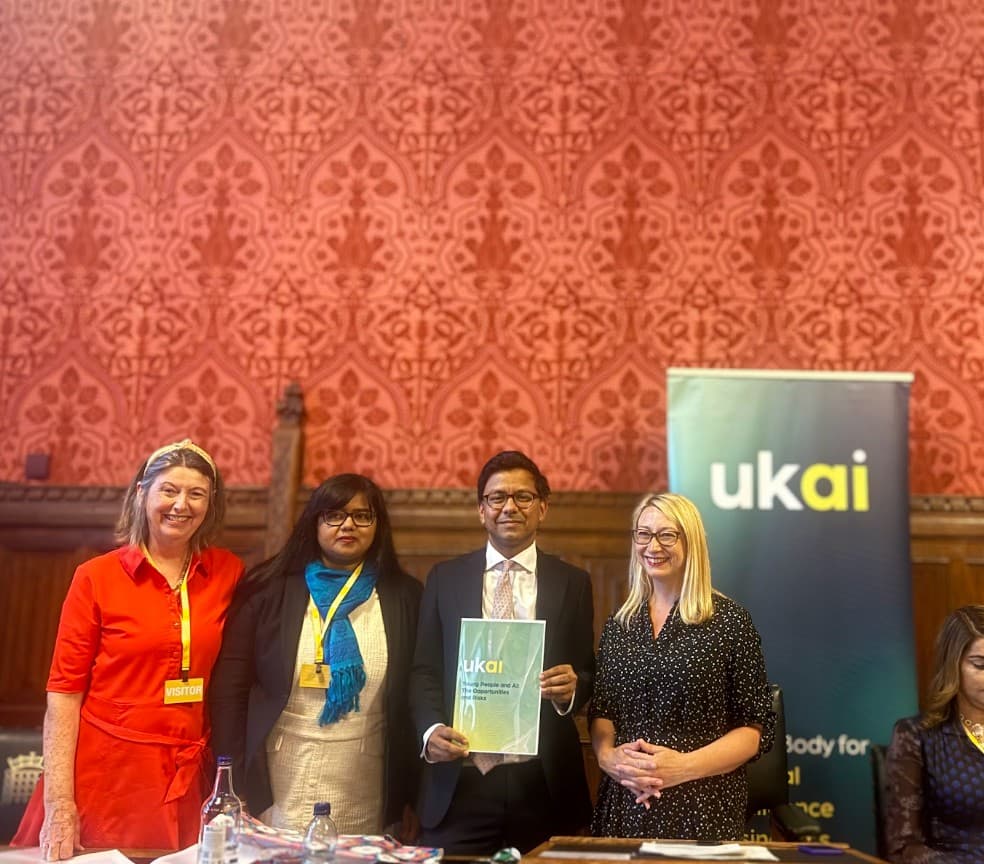
On 15 July 2026, UKAI (UK AI Limited) convened a closed-door, invite-only roundtable, Women Leading Britain's AI Future: Safe, Inclusive, High-Growth, in Central London / Palace of Westminster, with partners across Parliament and the National Council of Women Great Britain (NCW GB).[1]Link to footnote[2]Link to footnote The gathering sat at the intersection of industrial strategy, gender equity, and technology policy: decision-makers from technology firms, Parliament, and civil society addressing systemic design vulnerabilities in current AI deployment models.[1]Link to footnote
Particular notes are due to Jess Asato MP for hosting; to Kanishka Narayan MP, Minister for AI and Online Safety, for his supportive remarks and for launching UKAI’s Young People and AI: The Opportunities and Risks report; and to Baroness Manzila Uddin for her support.[1]Link to footnote
The core agenda was operationalising Safety by Design, safety protections, age-appropriate architectural boundaries, and risk mitigation built into products before commercial release, not patched on after harm spreads.[1]Link to footnote Discussion centred on disproportionate harms to women and girls: algorithmic bias, toxic recommendation loops, and the escalation of non-consensual synthetic intimate media and deepfakes, and on the link between those failures and the underrepresentation of women on design and product-governance teams.[1]Link to footnote
This is a difficult problem. Reactive moderation cannot keep pace with generative harm. Voluntary watermarking fails on open weights. Helpline budgets lag caseloads. Talent gender gaps have been frozen for fifteen years. No single actor, frontier lab, cloud platform, Ofcom, Parliament, or civil society, can close the gap alone.
Structured around five lines of inquiry, participants evaluated platform accountability, recommendation-engine redesign, design-stage provenance tagging, technical-team diversification, and a national evidence base aligned with G7 commitments.[1]Link to footnote For the UK to remain a safe, high-growth AI leader, diversity and safety cannot be peripheral compliance, they must be structural enablers of market stability, system reliability, and public trust.[1]Link to footnote
This Impact Intelligence Lab note is a field guide, not a grand blueprint. It maps those five pillars and the UKAI BRIDGE roadmap against Revenge Porn Helpline evidence, Online Safety Act practice, Ada Lovelace / Turing UK attitudes data, GIRAI 2026, and the Stanford AI Index 2026, and names concrete checks that rebalance power among labs, platforms, regulators, and communities.[1]Link to footnote[44]Link to footnote[45]Link to footnote[46]Link to footnote
Macro-Policy Context and Event Sequencing
The session landed in a period of intensive UK tech-policy formulation.[4]Link to footnote Mid-2026, UKAI ran a sequence of specialised events on the operational challenges of the AI landscape.[1]Link to footnote The 15 July roundtable was the bridge in that schedule: it followed a 14 July parliamentary dialogue with Energy Minister Michael Shanks MP on infrastructure and deployment, and preceded a 16 July conference on AI accountability, legal liability, and technical standards.[1]Link to footnote
That sequencing is the argument. Energy and compute without safety checks, or liability without inclusive threat modelling, leaves growth hollow. Establishing safety standards and inclusive design teams is not a social side-project, it is a legal and operational prerequisite for enterprise accountability and sovereign technology infrastructure.[1]Link to footnote
UKAI mid-summer AI calendar, safety as infrastructure prerequisite
| Date | Event | Core objective | |
|---|---|---|---|
| infra | 14 Jul 2026 | In Conversation with Minister Michael Shanks MP | Energy security, bills, national compute infrastructure |
| women | 15 Jul 2026 | Women Leading Britain's AI Future | Safety by Design, provenance, inclusive teams; ministerial remarks |
| liability | 16 Jul 2026 | AI Accountability, Liability and Standards | Corporate governance, liability, technical standards |
| rai | 21 Jul 2026 | Responsible AI Workshop | Ethics into day-to-day software workflows |
| sovereign | 2 Nov 2026 | Sovereign AI Summit | Compute, sovereign weights, procurement, exports |
Who was in the room
Attendance was vetted to balance government, industry, and civil society; individual delegate lists for closed sessions remain confidential.[1]Link to footnote Institutional and parliamentary voices shaping the agenda include:
Jess Asato MP
Hosted the parliamentary Women in AI roundtable in Westminster.
Kanishka Narayan MP
Supportive remarks; launch of UKAI Young People and AI: The Opportunities and Risks.
Baroness Manzila Uddin
Parliamentary support for inclusive AI safety.
Zahra Shah
Inclusive governance, frontier advisory, and FinTech transformation.
Claire Roberts
Enterprise AI ethics and internet-harms research with NCW GB.
Cecilia Jastrzembska
Tech-facilitated gender violence and international regulatory alignment.
Dr. Natalie Turney
Civil-society advocacy, UN CSW representation, and online safety policy.
Technical leads spoke to model limits; civil society brought harm data; parliamentarians and the Minister tested what law and procurement can enforce.[1]Link to footnote Diversity and safety remain structural enablers of market stability and public trust, not peripheral compliance.[1]Link to footnote
Five checks from the floor
The roundtable organised debate around five pressure points. Each is a check on concentrated design power, labs and platforms write the defaults; governments and civil society must reclaim agency without freezing innovation.[1]Link to footnote
Product check
Safety by Design before release, protective defaults, age-appropriate architecture, pre-deployment accountability.
Recommendation check
Safety-weighted valuation, design-stage friction, and transparent moderation boundaries against engagement-only funnels.
Provenance check
C2PA, watermarking, labelling, and training-set restrictions, necessary but insufficient without strict liability.
Talent check
Team demographics as threat-modelling capacity, red-teaming blind spots when women are absent from design.
Evidence check
G7-aligned national repository co-stewarded by Parliament, UKAI, and NCW GB.
Safety by design means building protection into digital products from the start not patching harm after it happens. It means protective defaults, age-appropriate experiences, and recommendation systems that elevate safe content rather than chase engagement.
, Official event framing, UKAI[1]Link to footnote
1. Product check, Safety by Design before release
Shipping unvalidated generative systems and patching later is unsafe at algorithmic speed. Reactive moderation processes harm only after damage is done.[1]Link to footnote
Protective defaults
Age-appropriate architecture
Pre-deployment accountability
Safety by design puts the responsibility where it belongs, on developers and platforms to anticipate gender-based risks before products ship. For the UK to lead on AI safely and inclusively, women must help write the rules, not just live with them.
, Official agenda briefing, UKAI[1]Link to footnote
2. Recommendation check, safety-weighted valuation
Engagement-maximising funnels amplify misogynistic content, radicalising narratives, and “manosphere” networks reaching young users.[1]Link to footnote Optimisation that rewards provocation is not neutral product design, it is a power allocation.
Safety-weighted valuation
Re-score recommenders so verified safe content can outrank high-engagement extremes.
Design-stage friction
Insert pauses when telemetry shows rapid consumption of extreme streams, without centralising arbitrary speech bans.
Transparent boundaries
Curtail radicalisation funnels while keeping free-expression limits visible and contestable.
3. Provenance check, deepfakes and non-consensual synthetic imagery
Generative tools have lowered barriers to non-consensual deepfakes and tech-facilitated violence against women.[1]Link to footnote[3]Link to footnote Technical interventions are necessary and insufficient:
C2PA provenance
Embeds immutable metadata at the generation layer to track origin.
Imperceptible watermarking
Applies invisible structural signals within generated image and video frames.
Automated labelling
Scans and flags synthetic human imagery prior to public index distribution.
Training-set restrictions
Audits training pipelines to block ingestion of non-consensual imagery.
Consensus: provenance and watermarking must be backed by legal mandates treating hosting or distribution of un-watermarked synthetic intimate imagery as a strict-liability offence.[1]Link to footnote Labs and hosts hold the generation layer; law must close the gap open weights leave open.
4. Talent check, demographics as threat-modelling capacity
Homogeneous product and governance teams produce blind spots in how features can be weaponised against women and girls.[1]Link to footnote Diversity is an engineering requirement for accurate red-teaming, not a pipeline narrative alone.
Women and girls bear the brunt of algorithmic bias, online abuse, deepfakes, and non-consensual intimate imagery, yet are largely absent from the teams designing these systems.
, Risk assessment guidance, UKAI[1]Link to footnote
Industry commentary around the event cited Lovelace Report framing that mid-career departure of female talent costs the UK technology sector roughly £2.0–3.5 billion annually, linking retention failure to weakened safety engineering capacity.[18]Link to footnote
UK top AI authors and inventors, gender share (AI Index 2026)
- United Kingdom27.4% F72.6% M
- United States27.7% F72.3% M
- Parity benchmark50%50%
5. Evidence check, G7-aligned national repository
The final pillar translated G7 Hiroshima AI Process principles into a UK delivery ask: a shared national evidence repository co-stewarded by Parliament, UKAI, and NCW GB to aggregate internet-harms data, audit model bias, and keep statutory standards current with technical change.[1]Link to footnote
Civil society pressure already ran ahead of the closed door. NCW GB open letters and UN CSW interventions urged stricter digital safety laws; without equal representation and enforceable governance, adoption risks hard-coding gender inequality into future infrastructure.[3]Link to footnote[48]Link to footnote[5]Link to footnote
National evidence repository, three stewardship checks
1. Harms evidence, what the numbers force onto the agenda
Generative AI shifted digital abuse from redistributing authentic private imagery to manufacturing synthetic intimate content at scale. Women, girls, and marginalised communities carry the disproportionate cost, to mental health, work, and civic voice.[12]Link to footnote[13]Link to footnote
Quantitative prevalence
The Revenge Porn Helpline (RPH), operated by SWGfL, recorded a 106% rise in intimate-image abuse reports between 2022 and 2023, then a further 20.9% rise across 2024.[11]Link to footnote Globally, AI-generated pornographic imagery production expanded by 464% in a single year; prevalence studies find 99% of deepfake pornography targets are female.[13]Link to footnote[26]Link to footnote
By late 2023, a sample of 34 primary nudification services drew over 24 million unique monthly visitors.[16]Link to footnote Open-source diffusion weights and commercial suites have dropped the technical barrier near zero. August 2025 tests of xAI’s Grok Imagine “Spicy” preset showed unmoderated models can instantly generate explicit, non-consensual depictions of public figures and private individuals.[13]Link to footnote[16]Link to footnote
Platforms and model hosts hold the generation layer. Civil society absorbs the aftermath. That imbalance is the governance failure.
Intimate-image abuse and synthetic pornography, selected escalation metrics
Deepfake exposure, UK adults vs 18–24 cohort
- Deepfake image / AV clips58%85%
- False / misleading information61%81%
Safety indicators cited at the roundtable
| Metric / safety indicator | Quantitative value | Primary source | |
|---|---|---|---|
| rph-106 | RPH intimate-image abuse growth (2022–2023) | +106% YoY | Revenge Porn Helpline Annual Report |
| rph-21 | RPH intimate-image abuse growth (2023–2024) | +20.9% YoY | UK Parliament WEC / RPH data |
| ai-porn | Global AI pornography production | +464% in a single year | Home Security Heroes study |
| female-targets | Female share of deepfake pornography targets | 99% | Global gender-harms empirical survey |
| nudify | Top nudification-app monthly audience | 24M unique visitors (34 services) | IPU / NGO analysis |
| takedown | RPH historical content-removal efficiency | 90% takedown across 305k+ images | Revenge Porn Helpline impact data |
UK public exposure and concern
The Ada Lovelace Institute and Alan Turing Institute surveyed 3,513 UK residents in November 2024. Exposure to AI-linked harms is already mainstream, not speculative.[44]Link to footnote Close to two-thirds (67%) have experienced any form of such harm a few times; over a third (39%) many times. Deepfakes sit with fraud and false information at 58% exposure. 94% of adults are very or somewhat concerned about AI-generated harms online.[44]Link to footnote
Among 18–24-year-olds, 85% report encountering deepfakes and 81% false information.[44]Link to footnote Men report higher raw exposure than women, but lower female self-reports may reflect adaptive withdrawal (limiting photos, posts, and online visibility) rather than lower risk.[44]Link to footnote When women exit public channels to stay safe, democratic voice thins. That is a checks-and-balances failure, not only a content-moderation failure.
Trauma, visibility traps, and why voluntary fixes fail
Victims face PTSD pathways, anxiety, depression, isolation, and suicidal ideation.[13]Link to footnote Seyi Akiwowo (Glitch) names the pattern “unstructured harm” from commercial “profit-by-design” models, and a “visibility trap” where women who gain public office or professional standing face clustered digital attacks meant to force withdrawal from discourse.[13]Link to footnote
Documented pathways include high-profile prosecutions that spike disclosures (Georgia Harrison, 2023); schools as sites of minor-on-minor nudification that blurs peer harassment and CSAM generation; and “collector culture” where synthetic imagery is bundled with social handles and traded for status or money.[13]Link to footnote[27]Link to footnote[29]Link to footnote
Dr. Shweta Singh (Warwick Business School; UN CSW delegate) argues reactive, vendor-specific watermarking fails as a primary defence: voluntary commitments lack uniform standards, can be stripped in post-processing, and cannot stop redistribution on encrypted messengers. Governance must move upstream, structural prevention and binding accountability.[17]Link to footnote[28]Link to footnote
GIRAI 2026 places the same imbalance at global scale: 38% of women report experiencing online violence and 85% report witnessing it, while AI-powered deepfake content heavily targets women and girls and poorly safeguarded chatbots enable extreme abuse scenarios.[45]Link to footnote
GIRAI conceptual framework, five dimensions × three pillars
Loading GIRAI figure…
GIRAI, Framework coverage of gender equality by region
Loading GIRAI figure…
GIRAI, AI safety and security framework growth by region
Loading GIRAI figure…
2. Regulation, rebalancing duty between platforms, states, and the public
Stopping synthetic misogyny means moving from after-the-fact takedowns to prevention-focused duties of care. The UK’s Online Safety Act 2023 (OSA), administered by Ofcom, is the main domestic instrument.[14]Link to footnote[15]Link to footnote It both constrains platforms and depends on them for execution. That dual role is the hard part.
Regulatory philosophy, UK Online Safety Act vs EU AI Act
Online Safety Act implementation roadmap
Ofcom’s 2024–2025 schedule introduced enforceable standards:
- Illegal Harms Codes (17 March 2025), risk assessments and automated moderation for illegal content, including NCII and CSAM, without waiting for viral harm.[14]Link to footnote
- Child safety and age assurance (25 July 2025), Highly Effective Age Assurance (HEAA) on adult and generative explicit services, even as tools proliferate.[15]Link to footnote
- Guidance for women and girls (25 November 2025), platform duties on gendered cyber-harassment, misogyny, and deepfake threats.[37]Link to footnote
Ofcom can fine up to £18 million or 10% of Qualifying Worldwide Revenue (QWR), with joint and several liability across global corporate structures, a capital check on platforms that try to isolate subsidiary risk.[15]Link to footnote[34]Link to footnote
Ofcom Online Safety Act, enforceable windows (illustrative day counts from 2025 baseline)
UK OSA stack (2025)
17 Mar Illegal Harms → 25 Jul HEAA → 25 Nov women & girls guidance
UK Online Safety Act 2023 vs EU Artificial Intelligence Act
| Governance parameter | UK Online Safety Act 2023 | EU Artificial Intelligence Act | |
|---|---|---|---|
| philosophy | Regulatory philosophy | Systemic duty of care; outcome-focused platform safety systems | Horizontal product safety; risk-tiered AI classification |
| deepfake | Deepfake & nudification mandates | Hash-matching; rapid take-down for non-consensual intimate media | Transparency, watermarking; EU-wide bans on targeted nudifier apps |
| minors | Minor protection standard | HEAA mandatory on generative and adult services | Systemic risk duties under DSA and AI Act |
| penalties | Financial penalty limits | Up to £18M or 10% of QWR | Up to €35M or 7% of global turnover (banned practices) |
| jurisdiction | Statutory jurisdiction | User-to-user services, search engines, UK-accessible hosted content | Developers, deployers, importers, distributors in the EU market |
Criminal law evolution and remaining gaps
Amendments to Section 33 of the Criminal Justice and Courts Act 2015 (effective 31 January 2024) removed the need to prove intent to cause distress for non-consensual intimate image sharing.[12]Link to footnote Later 2024–2025 legislation created offences for creating sexually explicit deepfakes whether or not the image was published.[15]Link to footnote
Two gaps still blunt enforcement:
- Intent loopholes, malicious-intent thresholds that let perpetrators claim “testing,” satire, or personal entertainment.[27]Link to footnote
- Commissioning gaps, when someone pays a third party or automated service to generate NCII, solicitor liability is inconsistently captured.[27]Link to footnote
Law without those closures leaves the check incomplete.
Capability-based governance and cross-border friction
Jessica Smith (University of Southampton) argues regulation must track capabilities across the lifecycle, fine-tuning, retrieval augmentation, and platform integration defy static pre-launch product labels.[20]Link to footnote Christina Tueje (GRC Information Management) flags the practical clash: UK platform duties of care versus the EU AI Act’s product-safety tiers and nudification bans. Enterprise programmes must satisfy both without centralising compliance only in the largest firms.[13]Link to footnote[21]Link to footnote
What the UK public wants from regulation
Ada Lovelace / Turing findings show demand for law rising faster than the UK’s comprehensive AI statute. Citizens want shared responsibility, not private-only control.
UK public comfort levers, 2022/23 vs 2024/25
- Laws & regulations62%72%
- Welfare AI concern44%59%
Concern about AI in welfare eligibility assessment rose from 44% (2022/23) to 59% (2024/25), trust collapses fastest where automation touches vulnerable groups.[44]Link to footnote Facial-recognition concern is 39% overall but 57% among Black respondents and 52% among Asian respondents; false-accusation concern reaches 66% / 62% in those groups versus 54% overall.[44]Link to footnote Public comfort is a distributed check. Ignore demographic splits and the “average” citizen becomes a fiction that licenses harm.
Facial recognition in policing, concern by demographic group
- Concern, Black respondents39% all57% Black
- Concern, Asian respondents39% all52% Asian
- False-accusation concern, Black54% all66% Black
- False-accusation concern, Asian54% all62% Asian
3. Inclusion, talent and data as safety capacity, not soft equity
Safety fails when design teams, training data, and boards exclude the people most exposed to abuse. UKAI Women in AI treats underrepresentation of women and ethnic minorities as a structural design flaw, it impairs model safety and performance, not only fairness optics.[1]Link to footnote
Data bias and intersectional degradation
Dr. Sarah Wyer (Durham University) has mapped gender and intersectional bias across LLM training sets from early GPT architectures through GPT-5 iterations: uncritical web-scale ingestion encodes occupational stereotyping, hyper-sexualisation of female subjects, and erasure of intersectional identities.[5]Link to footnote[19]Link to footnote When those models enter recruitment, credit, policing, or healthcare, they scale institutional discrimination.[1]Link to footnote
Christina Tueje presses for mandatory disaggregated demographic audits (age, gender, ethnicity) across design teams and boards, inclusive governance as reliability engineering.[21]Link to footnote Without that check, bias remains invisible until victims absorb the cost.
Global talent parity has not moved
Stanford AI Index 2026 finds the gender gap among AI authors and inventors in every measured country, with no meaningful progress from 2010 to 2025 despite overall talent growth.[46]Link to footnote Female shares peak around Saudi Arabia (32.3%), Australia (30.1%), Canada (29.6%), and Italy (29.5%); Brazil, South Korea, and Japan remain above 80% male. The United Kingdom sits at roughly 27.4% female, comparable to the United States (27.7%), far from parity.[46]Link to footnote
Female vs male share of top AI authors and inventors
- Saudi Arabia32.3%67.7%
- Australia30.1%69.9%
- Canada29.6%70.4%
- United Kingdom27.4%72.6%
- United States27.7%72.3%
- Germany21.8%78.2%
- South Korea18.6%81.4%
- Japan17.5%82.5%
Education pipelines show the same lag. In US AI-software-related degrees, women peak at 36% of master’s graduates and remain lower in hardware tracks; globally, women average about 20–29% of ICT graduates by degree level, while women earn nearly 60% of all degrees overall.[46]Link to footnote Talent checks fail early. Retention and red-teaming cannot recover what pipelines never produce.
GIRAI: gender named, gendered harms under-protected
GIRAI 2026 documents 29 new countries addressing gender and AI since the first edition, one of the fastest-growing policy areas, yet Gender Equality still ranks structurally low. 55 countries have gender–AI frameworks; only 24 show implementation evidence. Few governments address misinformation used to facilitate gender-based harassment, or provide accessible redress for AI-facilitated gendered violence.[45]Link to footnote
The UK ranks #7 globally (score 67.27), with relatively strong Inclusion & Diversity (77.77) and Labour & Skills (78.26), but Trust & Safety (66.01) and AI in Public Service (64.86) lag, and CSO Engagement (54.44) remains a soft spot for participatory oversight.[45]Link to footnote Scores without civil-society teeth are signalling, not checks.
UK GIRAI dimension profile vs European peers
| Metric | United Kingdom (#7) | Netherlands (#5) | Norway (#1) | France (#4) |
|---|---|---|---|---|
| Inclusion & diversity | 77.8score | 81.6score | 76.1score | 74.7score |
| Ethics & sustainability | 74.8score | 80.5score | 75.1score | 75.9score |
| Labour & skills | 78.3score | 72.3score | 75.2score | 74.8score |
| Trust & safety | 66.0score | 83.7score | 75.8score | 74.6score |
| Public-service AI | 64.9score | 68.1score | 74.2score | 78.1score |
| CSO engagement | 54.4score | 57.9score | 42.9score | 57.7score |
GIRAI scores by region
Loading GIRAI figure…
GIRAI, AI literacy vs children's rights protection
Loading GIRAI figure…
GIRAI, AI-facilitated misinformation and violence frameworks
Loading GIRAI figure…
GIRAI, Global North vs Global South responsible-AI gap
Loading GIRAI figure…
GIRAI, Commitment → framework → implementation funnel by dimension
Loading GIRAI figure…
GIRAI, Framework topic growth since 1st Edition
Loading GIRAI figure…
The UKAI BRIDGE Framework, six operational checks
To turn ethics into engineering, UKAI Women in AI developed the AI Inclusion (BRIDGE) Framework, six pillars between high-level guidelines and enterprise execution.[1]Link to footnote[23]Link to footnote[24]Link to footnote Think of them as checks and balances inside the firm: purpose gates, revenue models, participatory design, board oversight, access pathways, and hard safety blockers.
Brand & Purpose
Fundamental Rights Impact Assessments and red lines before training begins.
Revenue & Value
Human-centric productivity, augment capability, do not erase institutional knowledge.
Inclusion
Co-design loops and disaggregated demographic audits in data pipelines.
Distribution
Board-level AI oversight and human-in-command across borders.
Growth & Access
Literacy, regional hubs, and pathways that widen technical leadership.
Execution gates
Red-teaming, drift detection, and binding safety blockers before release.
UKAI BRIDGE Framework, pillars and operational implementation
| BRIDGE pillar | Theoretical foundation | Operational governance | |
|---|---|---|---|
| brand | Brand & Purpose | Beneficence and rights-based innovation | Pre-training Fundamental Rights Impact Assessments; red lines for unviable use cases |
| revenue | Revenue & Sustainable Value | Human-centric productivity | AI as human augmentation and capability growth, not headcount reduction alone |
| inclusion | Inclusion & Participatory Design | Democratised governance & civic GEO | Co-design loops, civic listening, disaggregated demographic audits in data pipelines |
| distribution | Distribution & Governance | Tiered accountability & oversight | Board-level AI oversight; human-in-command; cross-border regulatory alignment |
| growth | Growth & Democratic Access | Socio-economic mobility & reskilling | AI literacy, regional hubs, technical pathways that widen leadership pipelines |
| execution | Execution & Safety Gates | Technical assurance & risk management | Deployment gates, adversarial red-teaming, drift detection, binding safety blockers |
Claire Roberts (Full Fathom Five) and Sarah Wyer emphasise that long-term enterprise value accrues when AI extends institutional knowledge rather than erasing it, aligning the Revenue pillar with retention of mid-career women whose departure already costs UK tech an estimated £2.0–3.5 billion annually.[1]Link to footnote[18]Link to footnote
4. Accountability, who pays when systems fail
Accountability needs three checks working together: mandatory incident reporting, independent evaluation outside commercial incentives, and sustainable funding for frontline safeguarding.[11]Link to footnote[25]Link to footnote Today those checks are misaligned, platforms monetise engagement while charities absorb victim care.
Mandatory incident reporting and artificial negligence
James Wilson (Artificial Negligence; Red Circle AI) argues liability must move beyond voluntary self-regulation: deploying generative systems without rigorous risk assessment, failure-mode evaluation, and red-teaming constitutes statutory artificial negligence, a duty of care on corporate officers when unvetted automation causes foreseeable harm.[22]Link to footnote
Independent monitors modelled on the UK AI Safety Institute, pre-deployment red-teaming, adversarial stress tests, automated deployment gates, can issue binding blockers when safety filters fail or explicit-content generation capabilities emerge.[25]Link to footnote AI Index 2026 underscores the urgency: documented AI incidents rose to 362 in 2025 (from 233 in 2024), while responsible-AI benchmark reporting by frontier labs remains spotty relative to capability reporting.[46]Link to footnote
Documented AI incidents (selected years)
AI incidents vs RPH funding pressure (indexed contrast)
- Documented AI incidents233 (2024)362 (2025)
- RPH Home Office funding (£k)£150k freeze£300k (25/26)
Frontline safeguarding under fiscal stress
Helplines and watchdogs are public infrastructure in all but name. Their funding has not kept pace with generative harm.
Safeguarding infrastructure, funding vs demand pressure
| Entity | Primary focus | Funding baseline | Caseload & structural pressures | |
|---|---|---|---|---|
| rph | Revenge Porn Helpline (SWGfL) | Adult NCII victims; content removal | Frozen £150k (2020–23); £210k (24/25); £300k (25/26) | Caseload +700% since 2020; +106% / +20.9% report growth; 90% takedown on 305k+ images |
| iwf | Internet Watch Foundation | CSAM identification and removal | Industry subscriptions, grants, voluntary contributions | Explosive growth in AI-generated CSAM; hash-matching now essential |
| glitch | Glitch | Digital abuse against women and marginalised groups | Philanthropy, corporate partnerships, donations | Campaigning against profit-by-design models and unstructured harm to visible women leaders |
Revenge Porn Helpline, Home Office funding trajectory
Roundtable participants proposed a capital check: allocate a designated share of Ofcom regulatory fees and QWR penalties directly to frontline bodies. That creates an inflation-adjusted funding stream and forces platforms to support the civil-society infrastructure their products necessitate, without waiting for annual charity shortfalls.[11]Link to footnote[13]Link to footnote
5. Delivery roadmap, five gaps, five BRIDGE levers
Legislative and civil-society foundations exist. Research, policy, and technical execution still leave five structural gaps. BRIDGE supplies an operational matrix for each, a rebalancing of who acts, with which tools, under what constraints.
GIRAI, Framework coverage vs implementation evidence
Loading GIRAI figure…
GIRAI, Unacceptable-risk AI (URAI) government-use cases
Loading GIRAI figure…
Unaddressed gaps → BRIDGE operational solutions
| Policy / technical gap | Structural governance failure | BRIDGE solution | |
|---|---|---|---|
| oss | Open-source fine-tuning & model-weight safety | Hosted APIs cannot control offline nudification weights | Execution: pre-release alignment, hardware-level gates, open-weight audit standards |
| intersectional | Intersectional harm metrics & data disaggregation | Aggregate audits mask racialised and gendered compound abuse | Inclusion: mandatory multi-axis demographic logging and bias auditing |
| cost | Internalisation of civil-society safeguarding costs | Platforms monetise engagement; charities absorb victim care | Revenue & Distribution: statutory levy linking QWR penalties to helpline funding |
| lifecycle | Continuous post-market lifecycle assurance | Compliance treated as a static pre-launch checklist | Execution: drift detection, runtime monitoring, dynamic deployment gates |
| procurement | Participatory governance in procurement scorecards | Buy criteria dominated by cost and speed, not civil co-design | Purpose & Growth: Inclusive AI Procurement Scorecards with civic GEO evidence |
Actionable checks from the roundtable
This is a field guide for AI-aligned safety ecosystems, not a complete blueprint. The pressure points are clear: product defaults, recommendation metrics, provenance plus liability, inclusive threat modelling, shared evidence, and funded civil-society response. Agency sits with cities and procurement offices, founders and enterprise buyers, Parliament and Ofcom, helplines and communities, not with any single lab or ministry. If Safety by Design holds, upstream engineering replaces victim-led reporting as the primary loop; if it does not, growth hard-codes the visibility trap into sovereign infrastructure.
For Global South and impact readers, the UK case is a stress test. When a high-ranking GIRAI jurisdiction still underfunds NCII helplines, trails on Trust & Safety relative to Inclusion scores, and inherits a frozen AI talent gender gap, Safety by Design only travels if engineered as infrastructure reliability, provenance, liability, procurement, and funded response, not soft ethics branding.
- 1.[Women Leading Britain's AI Future: Safe, Inclusive, High-Growth, UKAI, https://ukai.co/ai-event-calendar/women-leading-britain-s-ai-future-safe-inclusive-high-growth.html; Women in AI Working Group](https://ukai.co/working-groups/women-in-ai.html)
- 2.National Council of Women GB, structure and advocacy
- 3.NCW GB signed letter to ministers on online protection
- 4.Sovereign AI Summit, UKAI
- 5.Championing Equality in AI, UKAI
- 6.UKAI Team
- 11.Tackling non-consensual intimate image abuse: Government Response, UK Parliament Women and Equalities Committee
- 12.Revenge Porn Helpline 2023 Report
- 13.European Parliament / GHRD on industrialised misogyny and nudifier apps
- 14.Ofcom online safety duties, UK Parliament written evidence
- 15.Online Safety Act collection, GOV.UK
- 16.Combating non-consensual intimate imagery, IPU parliamentary action guide
- 17.Shweta Singh, INvolve Empower profile
- 18.Lovelace Report / WeAreTechWomen One Tech World agenda framing
- 19.Women in AI: AI, Gender Bias and Online Safety, Sarah Wyer
- 20.Capability-based governance framing, Southampton / ECPR panel context
- 21.Christina Tueje, AI, Privacy and Technology leadership interview
- 22.James Wilson, Artificial Negligence / AI and You
- 23.UKAI Women in AI / Bridge framework discussion context
- 24.The Bridge Framework, Ethos Institute
- 25.Audit-as-code continuous AI assurance, PMC
- 26.Deepfake as abuse, European Public & Social Innovation Review
- 27.Sexual deepfakes, The Guardian
- 28.Responsible AI and election deepfakes, Warwick Business School
- 29.RPH reports +106% in 2023
- 34.Digital regulation, UK Regulatory Outlook July 2025, Osborne Clarke
- 37.Ofcom Online safety industry bulletin, December 2025
- 44.Ada Lovelace Institute & Alan Turing Institute, How do people feel about AI? Wave two (March 2025), nationally representative survey of 3,513 UK residents (November 2024)
- 45.Adams et al., Global Index on Responsible AI 2026 (2nd Edition), Global Center on AI Governance (CC BY 4.0)
- 46.Sajadieh et al., The AI Index 2026 Annual Report, Stanford Institute for Human-Centered AI (CC BY-ND 4.0)
- 47.Full Fathom Five AI
- 48.News Archives, National Council of Women GB
- 49.Online harms motion, NCW GB / ECICW