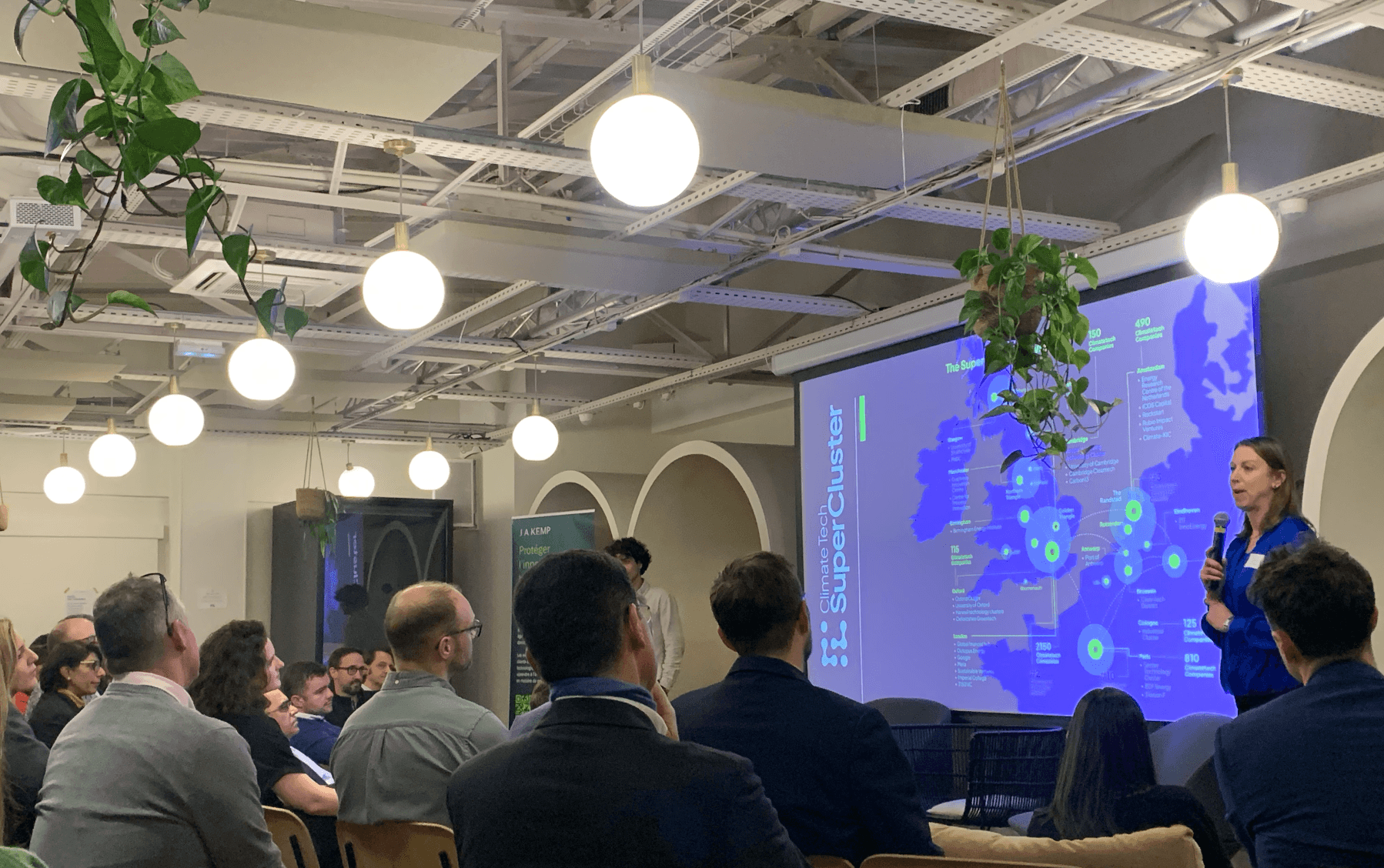
Issy-les-Moulineaux, collision hour
We attended Cleantech Venture Day Paris 2025, hosted by the Climate Tech SuperCluster at Capgemini's headquarters in Issy-les-Moulineaux. Sam Goodall, CEO of Cambridge Cleantech and co-founder of the SuperCluster, described the initiative's goal as increasing the "collision rate" between innovators, corporate venture arms, and global investors across hubs including London, Amsterdam, and Paris.
For operators, the event underscored that regional cluster design directly affects capital deployment velocity, and that MRV-first, audit-ready evidence increasingly replaces narrative in diligence conversations. This briefing synthesises what we observed on the floor: cluster architecture, compliance-ready data stacks, and cross-border financing pathways for climate innovation.
Climate tech is structurally different from SaaS: it is capital-intensive, asset-anchored, and jurisdiction-sensitive. Pitches from Mykor (fungal-mycelium building insulation) and Shifted (long-duration storage without critical raw materials) illustrated the hardware-heavy profile dominating investor interest. Corporate participants included James Lockyer (Microsoft Climate Innovation Fund), Johann Boukhors (ENGIE New Ventures), Michel Hunsicker (EDF Pulse), and Florent Andrillon (Capgemini Climate Tech). The investor message was consistent: software wrappers around carbon accounting are insufficient; bankable projects need physical assets with verified environmental performance.
Not enough
Carbon accounting as a software wrapper
Dashboards without verification primitives (methodologies, provenance, audit interfaces) rarely clear institutional diligence in asset-heavy climate markets.
Bankable
Hardware + continuous MRV evidence packages
Projects that link facility metering, spatial provenance, and standards-aligned reporting can survive cross-jurisdiction audits and unlock project finance.
Corporate venture arms at the event treated data architecture as a diligence gate. James Lockyer (Microsoft Climate Innovation Fund) and Johann Boukhors (ENGIE New Ventures) framed investment decisions around whether ventures could produce audit-ready evidence of environmental performance, not slide-deck emissions estimates. Florent Andrillon (Capgemini Climate Tech) emphasised that cross-border deployment fails when regional data formats cannot be reconciled with European compliance expectations.
Corporate venture perspective
Capital wants auditability
Operator perspective
Build for export by default
For operators in emerging markets such as Southeast Asia, the Paris sessions underscored that hyper-transparent data layers are not optional extras. They are prerequisites for cross-border project finance. Cluster organisations function as trust brokers: they vouch for ventures that have passed technical and compliance screening, accelerating investor conviction in unfamiliar jurisdictions.
Compliance-ready data architecture
To unlock European capital markets, digital verification infrastructure must be engineered for cross-jurisdictional auditability from day one. Whether tracking industrial supply chains or verifying natural carbon sinks, architectures must withstand strict international compliance criteria: CBAM attestations, CSDDD chain-of-custody, and institutional ESG due diligence.
Aligning regional data frameworks with European open digital standards[1]Link to footnote is the fastest pathway to de-risking project deployment at scale.
SuperCluster collaboration models offer a template: connect regional spatial-intelligence providers to European corporate venture and infrastructure funds through shared data standards and mutual recognition of MRV methodologies. Operators who build compliance-ready pipelines with versioned calculations, spatial provenance, and third-party audit interfaces reduce friction for investors evaluating projects across borders.
Impact Intelligence Lab's systems-thinking approach maps directly onto this requirement. Environmental intelligence that links satellite observation, facility metering, and policy-aligned reporting formats transforms fragmented regional data into bankable evidence packages.
Cross-border operator playbook
For founders, the Climate House Paris takeaway is architectural. Design APIs and data schemas for multi-jurisdiction export. Document methodologies against recognised standards. Build investor-facing dashboards that surface verification status, not just emission totals. Partner with cluster organisations early, they function as distribution channels for diligence-ready ventures.
Exportable data primitives
Define stable schemas for measurements, methodologies, and provenance so downstream reporting can be regenerated and audited across jurisdictions.
Compliance-ready reporting
Map outputs to EU-style requirements early so procurement and finance teams do not need bespoke conversions when projects scale beyond one market.
Investor-facing verification
Build dashboards that show verification status, evidence coverage, and audit trail completeness, not only totals, so diligence becomes faster and repeatable.
The Paris ecosystem demonstrated that cross-border synergy is not achieved through networking alone. It requires shared compliance infrastructure that makes projects legible to capital regardless of where they originate. Climate-tech operators who invest in that infrastructure will access global capital pools that remain closed to narrative-driven pitches.
Institutional capital and cluster strategy
Sam Goodall's SuperCluster model treats regional hubs as interoperable nodes rather than competing silos. London, Amsterdam, and Paris each contribute distinct strengths: venture depth, corporate partnership density, and policy proximity. For Southeast Asian operators, the lesson is to embed into these networks early with diligence-ready data products rather than waiting for inbound investor tours.
Mykor and Shifted exemplify the hardware-heavy ventures attracting corporate and infrastructure capital: circular building materials and long-duration storage without critical-raw-material dependencies. Both require continuous MRV to substantiate environmental claims across jurisdictions. Impact Intelligence Lab's approach, linking satellite observation, facility metering, and policy-aligned reporting, maps directly onto the evidence packages these ventures and their investors require.