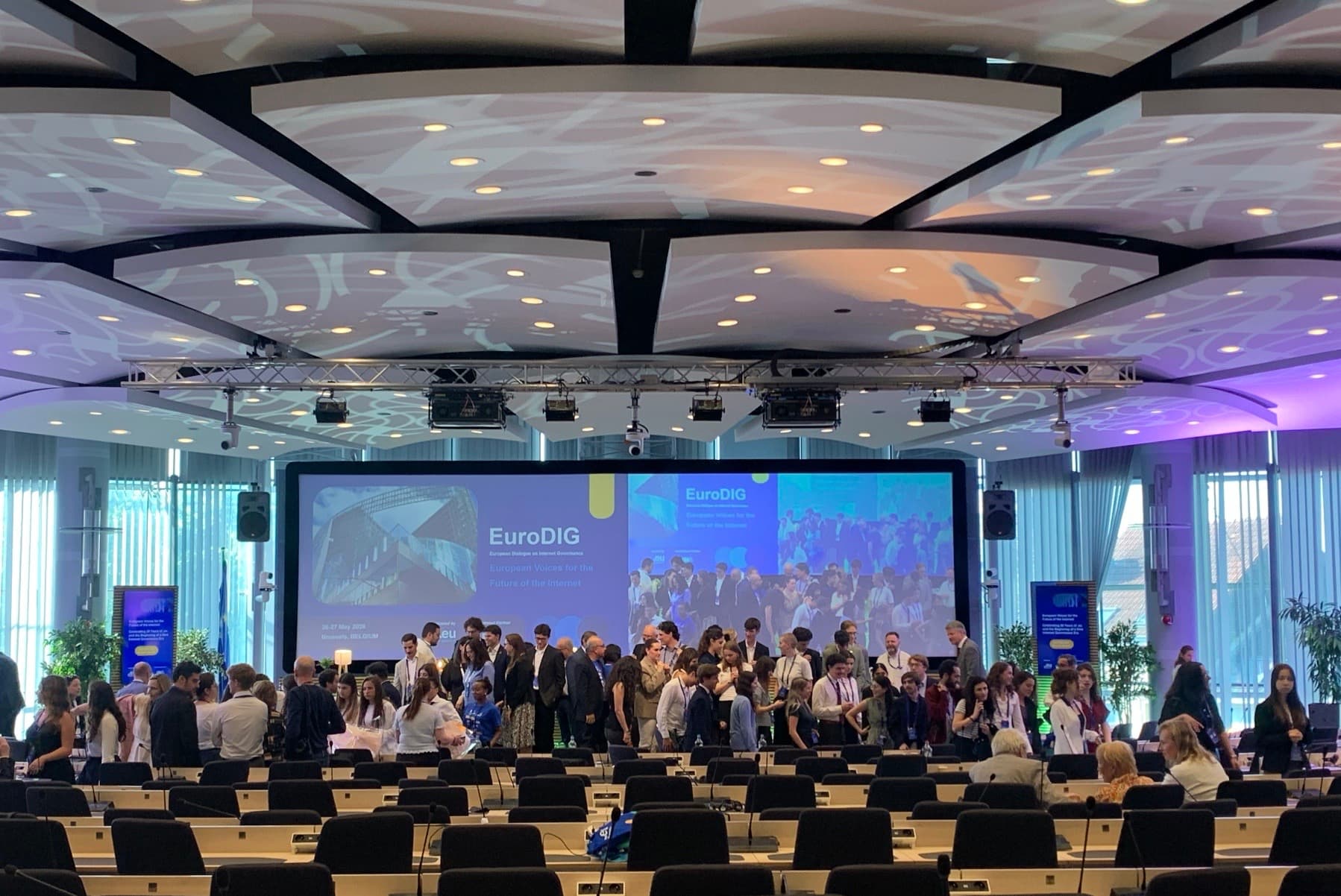
EuroDIG at the Charlemagne Building
We attended the 2026 European Dialogue on Internet Governance (EuroDIG)[24]Link to footnote[17]Link to footnote[1]Link to footnote at the Charlemagne Building of the European Commission in Brussels. Under the theme European Voices for the Future of the Internet – Celebrating 20 Years of .eu and the Beginning of a New Internet Governance Era, the conference marked two decades of the .eu registry[25]Link to footnote and convened institutional, technical, civil-society, and industrial leaders across parallel plenaries, workshops, and pre-events.[22]Link to footnote
Proceedings made clear that internet governance is no longer confined to logical protocol layers; discussions ranged from WSIS+20 alignment and the Global Digital Compact to post-quantum transition (Q-Day), hyperscale data-centre energy footprints, and physical supply-chain resilience.[10]Link to footnote[8]Link to footnote[3]Link to footnote The resulting policy frame emphasises a dual mandate for Europe: preserve open, interoperable internet standards while deploying digital sovereignty and sustainable infrastructure.
This briefing examines that convergence, multi-stakeholder governance, clean digital infrastructure, and regulatory alignments, from what we heard on the floor.
Major themes and topics
The conference agenda reflected a multi-stakeholder approach, organizing issue-driven sessions into parallel tracks of plenaries, workshops, and pre-events.[22]Link to footnote Discussions were characterized by intense deliberation over Europe's role in global governance frameworks following the adoption of the UN WSIS+20 Resolution.
EuroDIG 2026
| Overarching theme: European Voices for the Future of the Internet | ||||
|---|---|---|---|---|
| Global Digital Governance & WSIS+20 | Digital Sovereignty | Trustworthy AI & Information Integrity | Infrastructure Resilience & Quantum | |
| Parallel conference tracks | Global Digital Governance & WSIS+20 | Digital Sovereignty | Trustworthy AI & Information Integrity | Infrastructure Resilience & Quantum |
Global digital governance and the WSIS+20 review
A dominant segment of the program focused on aligning the outcomes of the UN World Summit on the Information Society (WSIS+20) Review with broader UN mechanisms, specifically the Global Digital Compact (GDC) and the Pact for the Future.[26]Link to footnote[15]Link to footnote Stakeholders emphasized that to avoid the fragmentation of global digital frameworks, Europe must leverage existing National and Regional IGF Initiatives (NRIs) to translate high-level international commitments into measurable operational realities.
Digital sovereignty and open strategic autonomy[6]Link to footnote
The debate on digital sovereignty focused on reducing Europe's dependence on foreign technological monopolies without triggering a fragmentation of the open internet. Participants explored the feasibility of regional infrastructure projects and scrutinized whether regulatory tools like the Digital Markets Act (DMA) can achieve sovereignty in the absence of deep industrial capacity and localized infrastructure investments.[9]Link to footnote
Trustworthy AI, content provenance, and public services
Integrating artificial intelligence into public administration and civil services requires strict adherence to transparency, explainability, and non-discrimination. Sessions examined automated decision-making (ADM) systems through the lens of human rights, assessing how new technical standards can combat online harms, gender-biased AI profiling, and generative AI-driven deepfakes.[14]Link to footnote
Physical supply chains and post-quantum security
The conference linked logical internet governance with physical vulnerabilities. Sessions addressed critical dependencies in semiconductor manufacturing, sustainable satellite networks, and clean energy grids. Additionally, significant attention was directed toward preparing the European digital ecosystem for "Q-Day" by developing and implementing Post-Quantum Cryptography (PQC).[5]Link to footnote
Technology trends and clean infrastructure integration
The conference expanded the boundaries of traditional internet governance by addressing the underlying hardware, space networks, and energy infrastructures that support global connectivity. The dialogue integrated digital standard-setting with environmental and physical supply chain logistics.
Clean energy and strategic supply chains for digital infrastructure
As computational demand rises, driven primarily by generative AI and automated public services, the stability of Europe's digital backbone has become structurally dependent on its physical supply chains. The panel Europe's Digital Backbone: Strategic Supply Chains for the Future of the Internet explored the convergence of the energy, semiconductor, and aerospace sectors.
A key highlight was the contribution of Renaissance Fusion, a French startup developing stellarator nuclear fusion reactors. The company aims to deliver clean, baseload energy to power hyperscale data centers and national telecommunication grids by the 2030s, offering a zero-emission alternative to fossil-fuel generation.
Simultaneously, the research institute imec presented strategies to mitigate the environmental impact of chip fabrication. Representing the "chip lab of the world," imec showcased research aimed at making nanoelectronics more resource-efficient and sustainable. By reducing energy and chemical footprints during manufacturing, these advancements address global pollution and climate concerns.
Additionally, the aerospace manufacturer PLD Space discussed the integration of sustainable small-satellite launch services, which are critical for maintaining sovereign low-Earth orbit (LEO) telecommunication constellations without creating excessive space debris.
Post-quantum cryptography and the "Q-Day" transition
Technical standard-setting was dominated by the post-quantum transition. Panelists warned that "Q-Day", the point at which quantum machines can break asymmetric encryption standards like RSA and elliptic curves, is an active structural concern rather than a distant threat.
The technical consensus highlighted a four-step framework presented by cybersecurity specialists for implementing Post-Quantum Cryptography (PQC):
PQC Implementation Framework
The transition requires translating mathematical primitives into operational protocols (such as updating TLS and DNSSEC) to prevent vulnerability gaps across interconnected systems.
PQC transition effort profile (illustrative)
Public administration
Broad asset surface area
Critical infrastructure operators
Tighter operational constraints
AI content provenance and technical standards[7]Link to footnote
To combat deepfakes, synthetic media, and information manipulation, the technical track reviewed standards under the EU AI Act and the European Democracy Action Plan. Discussions focused on the deployment of technical watermark and provenance tools, specifically Google's SynthID and the Coalition for Content Provenance and Authenticity (C2PA) framework. However, academic and industry contributors noted that while these standards are technically viable, deployment gaps remain due to a lack of mandatory consumer-facing platform integration and inconsistent cross-platform metadata retention.[23]Link to footnote
Investment and funding insights
Discussions on financing Europe's digital and ecological transitions highlighted the need for coordinated public funding and targeted private capital to scale critical technologies.
Strategic Funding & Investment Channels
| EuroDIG 2026 financing architecture | |||
|---|---|---|---|
| Public Funding & Sovereign Mandate | Strategic R&D Co-Investment | Infrastructure Equity & NRI | |
| Investment channel | Public Funding & Sovereign Mandate | Strategic R&D Co-Investment | Infrastructure Equity & NRI |
Public funding and sovereign mandates
Participants discussed the structural investment required to transition Europe's public administrative sector to secure, sovereign digital stacks. Initiatives like "Quantum Austria" were highlighted as successful models where public funding is directed to hand-in-hand research, security, and enterprise incubation.
Conversely, speakers identified severe funding shortages within regional equality bodies and public-sector oversight agencies.[21]Link to footnote These resource constraints limit their capacity to conduct algorithmic bias audits or enforce non-discrimination provisions under the EU AI Act.
Private capital and deep-tech co-investment
Developing deep-tech hardware, such as Renaissance Fusion's stellarator reactors and PLD Space's launch infrastructure, requires long-term capital that exceeds typical venture capital horizons.[20]Link to footnote Leaders called for public-private partnerships and blended finance mechanisms to derisk early-stage physical infrastructure deployment.
Investment in rural connectivity
Addressing regional divides, civil society and youth groups called for targeted public infrastructure investments in rural and under-resourced areas. They argued that access to the internet must be treated as a fundamental human right, requiring public subsidies to construct high-speed, resilient networks in commercially non-viable geographic regions.
Policy and regulatory developments
The conference took place amidst rapid regulatory activity within both European and global bodies. Deliberations focused on turning legislative texts into technical implementation.
The EU AI Act and national implementation strategies
With the EU AI Act in force, discussions turned toward national adaptation strategies. Spain's approval of a draft Organic Law designed to align its national legal framework with the EU AI Act was cited as a key development. This legislation establishes clear oversight structures and mandates human-in-the-loop validation for high-risk automated decision-making systems.
Furthermore, the Council of Europe introduced its Framework Convention on Artificial Intelligence alongside the Committee of Ministers' Recommendation on Equality and Artificial Intelligence (CM/Rec(2026)1), adopted in March 2026. This framework provides public administrations with tools to mitigate algorithmic discrimination and unequal access.
Sovereignty mandates and the "Deutschland-Stack"
Several EU member states have initiated concrete regulatory pathways to reduce reliance on non-European cloud and technology providers. France mandated that all ministries submit a digital sovereignty roadmap by autumn 2026, focusing on open-source collaborative tools and reducing reliance on extra-European services.
In parallel, Germany's IT-Planungsrat adopted Decision B-2026/03-IT (the "Deutschland-Stack") in March 2026. This framework mandates open standards for all levels of German public administration, serving as a technical template for public sector digital autonomy.
Alignment of the WSIS+20 review and the Global Digital Compact (GDC)[19]Link to footnote
A major policy focus was ensuring structural coherence between the WSIS+20 Action Lines and the newly established UN Global Digital Compact. EuroDIG stakeholders recommended utilizing existing, resource-efficient WSIS monitoring mechanisms rather than establishing parallel, duplicate oversight bodies within the UN system.[2]Link to footnote They advocated for a data-driven, evidence-based global roadmap to map GDC commitments directly to existing WSIS Action Lines, ensuring accountability and clear measurement criteria.
Partnerships and collaborations
The conference showcased several cross-sector partnerships aimed at bridging technical standards and human-centric policies.
The UNESCO–ICANN Universal Acceptance initiative
A key highlight of the closing plenary was the collaboration between UNESCO and ICANN to advance the Universal Acceptance (UA) of multilingual domain names and email addresses.[18]Link to footnote Introducing their joint Policy Brief, Advancing Universal Acceptance of All Domain Names and Email Addresses for a Multilingual Internet, the two organizations addressed technical gaps in systems that fail to recognize non-Latin scripts. This initiative aligns ICANN's Strategic Plan with the UNESCO Global Roadmap for Multilingualism to support digital inclusion in the AI era.[12]Link to footnote
Intergovernmental technical assistance: CyberEast+ and CyberSEE
The Council of Europe highlighted the ongoing progress of its multi-stakeholder technical capacity projects, CyberEast+ and CyberSEE. Collaborating with EU institutions, these projects facilitate regional cooperation in Eastern Europe and Southeast Europe. They assist national judicial and criminal justice authorities in aligning their legislative reforms with the Second Additional Protocol to the Budapest Convention while incorporating ethical safeguards for AI use.
Academia and governance: BSoG and YOUthDIG
The Brussels School of Governance (BSoG) played an active role in coordinating the Youth Dialogue on Internet Governance (YOUthDIG) pre-event. BSoG researchers and students led capacity-building tracks for young policymakers and co-moderated key technical tracks, including the post-quantum cryptography session and the information quality workshop. This collaboration helped prepare the next generation of digital policy leaders.
Geographic focus
The geographic dynamics of EuroDIG 2026 highlighted regional shifts in internet governance and infrastructure hosting within Europe.
The decentralisation of the "FLAP-D" data center hubs
Historically, European data center infrastructure has been concentrated in the "FLAP-D" markets:
- Frankfurt
- London
- Amsterdam
- Paris
- Dublin
However, analysis showed a clear migration toward secondary regions. Hyperscale developers are increasingly moving into the Nordics, Ireland's regional counties, and rural areas of the Netherlands. This geographic expansion is driven by the search for cheaper power, available land, and streamlined local planning permissions.
FLAP-D (legacy hubs)
Where capacity concentrated historically
Secondary regions (emerging)
Where hyperscalers are expanding
Risk
Sovereignty becomes a proxy for walled gardens
If sovereignty is implemented as incompatible standards or isolated stacks, the open internet’s interoperability erodes and compliance becomes duplicative.
Goal
Open strategic autonomy with interoperable standards
Participants repeatedly returned to the idea that sovereignty should be achieved through enforceable open standards, resilient supply chains, and capability-building, not protocol fragmentation.
East-West regulatory harmonisation
Through projects like CyberEast+ and CyberSEE, there was a strong emphasis on integrating Eastern European partners into the EU's cyber-resilience and digital rights frameworks. Representatives from various countries, including Armenia (represented by the Internet Society NGO), discussed local alignment with European internet standards and domain security policies.
Challenges and barriers[27]Link to footnote
The multi-stakeholder discussions identified several significant challenges that could hinder the successful integration of Europe's technological and environmental strategies.[13]Link to footnote[11]Link to footnote
The local toll of hyperscale data centers
While the expansion of data centers supports Europe's digital economy, it places a material burden on host communities. Hyperscale facilities drive up local electricity prices and shift water tables due to their cooling requirements. Furthermore, regional grid capacity that previously served residential areas is often redirected to meet the energy demands of these facilities.
YOUthDIG participants emphasized that this is a disparity issue: local communities carry the material costs of infrastructure decisions made by distant corporations with whom they have no direct relationship.[4]Link to footnote The lack of local consultation and benefit-sharing mechanisms remains a major barrier to community acceptance.
The PQC inequality divide and sluggish adoption
The transition to post-quantum cryptography faces two major challenges:
- The economic and security divide: Advanced PQC implementation is expensive and technically complex, raising concerns that only wealthy nations and large corporations will be able to afford quantum-resistant security, leaving smaller organizations and under-resourced regions vulnerable.
- Sluggish organizational adoption: Many organizations are slow to implement PQC because they lack clarity on where encryption is currently used in their systems. Additionally, a general lack of awareness among decision-makers prevents timely action.
The "first-mover disadvantage" in technical standardisation
Translating open standards into operational reality is often hindered by economic disincentives. Organizations that adopt new, complex, and sometimes non-backwards-compatible standards early face higher deployment costs and operational risks, creating a first-mover disadvantage. Without coordinated policy mandates or financial incentives, industry players tend to delay deployment, stalling the transition to secure protocols.
Strategic insights
The findings of EuroDIG 2026 provide key strategic directions for businesses, investors, and policymakers navigating Europe's digital and ecological landscapes.[16]Link to footnote
For businesses and technical operators: cultivate cryptographic agility
Enterprises must transition from static security models to cryptographically agile architectures. This requires maintaining detailed inventories of active encryption algorithms and ensuring that legacy protocols can be easily replaced with post-quantum standards as they are validated. Proactive compliance with national frameworks, such as the German "Deutschland-Stack" and French sovereignty roadmaps, will be critical for businesses bidding on public contracts.
For investors: focus on clean digital infrastructure
The energy footprint of AI and data routing requires a shift in investment strategies. Capital should be directed toward deep-tech innovations that decouple computational growth from resource depletion. This includes:
- Next-generation semiconductor research (e.g., sustainable nanoelectronics)
- Zero-emission baseload energy technologies (such as stellarator nuclear fusion)
- Modular, liquid-cooled, and resource-efficient data center architectures
For policymakers: champion human-rights-by-design and inclusive planning
Regulators must ensure that digital sovereignty policies do not compromise the open, interoperable nature of the global internet. To support local community acceptance of physical digital infrastructure, planning regulations should mandate full environmental transparency, resource utilization disclosures, and direct benefit-sharing mechanisms for host regions. Finally, to ensure trustworthy AI deployments, governments should build capacity in public procurement by training officers to buy "secure-by-design" and "human-centric-by-design" technologies.
For Impact Intelligence Lab, the EuroDIG sessions reinforce a core thesis: digital governance and environmental intelligence are converging at the infrastructure layer. Spatial monitoring of grid capacity, water use, and land allocation around hyperscale facilities; cryptographic provenance for AI-generated environmental data; and audit-ready compliance stacks for public-sector deployments are no longer adjacent product categories, they are the operational substrate of Europe's next internet governance era.
- 1.EuroDIG 2026 programme
- 2.EuroDIG 2026 - CADE - Civil Society Alliances for Digital Empowerment
- 3.Europe's Digital Backbone: Strategic Supply Chains for the Future of the Internet – Pre 02 2026 - EuroDIG Wiki, https://eurodigwiki.org/wiki/Europe%E2%80%99sDigital_Backbone:_Strategic_Supply_Chains_for_the_Future_of_the_Internet%E2%80%93_Pre_02_2026
- 4.YOUthDIG 2026 - EuroDIG Wiki
- 5.Q-Day Countdown: No More Privacy? – WS 08 2026 - EuroDIG Wiki, https://eurodigwiki.org/wiki/Q-DayCountdown:_No_More_Privacy%3F%E2%80%93_WS_08_2026
- 6.European Approaches to Digital Sovereignty – MT 02 2026 - EuroDIG Wiki, https://eurodigwiki.org/wiki/EuropeanApproaches_to_Digital_Sovereignty%E2%80%93_MT_02_2026
- 7.Internet Standards and Frontier Technologies: Lessons from the Past, Tasks for Today, Choices for the Future – WS 05 2026 - EuroDIG Wiki, https://eurodigwiki.org/wiki/InternetStandards_and_Frontier_Technologies:_Lessons_from_the_Past,_Tasks_for_Today,_Choices_for_the_Future%E2%80%93_WS_05_2026
- 8.European Dialogue on Internet Governance (EuroDIG) | Digital Skills and Jobs Platform
- 9.Mark your calendars for EuroDIG 2026! - EURid
- 10.BSOG contributes to the European Dialogue on Internet Governance 2026
- 11.Driving inclusive Digital Governance: CyberEast+ and CyberSEE foster multi-stakeholder collaboration at EuroDIG 2026 and beyond; CyberSEE's 5th Steering Committee advances regional co-operation - Cybercrime - The Council of Europe
- 12.EuroDIG 2026 closes with calls for multilingual internet and stronger digital inclusion
- 13.Council of Europe contributes to EuroDIG 2026 discussions on the future of Internet governance - Artificial Intelligence
- 14.20 Years of .eu: Together Shaping Europe Online – Pre 01 2026 - EuroDIG Wiki, https://eurodigwiki.org/wiki/20Years_of.eu:Together_Shaping_Europe_Online%E2%80%93_Pre_01_2026
- 15.WSIS+20 Review Outcomes and the Path to Implementation – MT 01 2026 - EuroDIG Wiki, https://eurodigwiki.org/wiki/WSIS%2B20Review_Outcomes_and_the_Path_to_Implementation%E2%80%93_MT_01_2026
- 16.EuroDIG News 09/2026 › EuroDIG
- 17.EuroDIG planning process
- 18.EuroDIG News 25/2026 › EuroDIG
- 19.Implementing WSIS+20 Review Outcomes through Collaboration amongst European National and Regional Initiatives – WS 07 2026 - EuroDIG Wiki, https://eurodigwiki.org/wiki/ImplementingWSIS%2B20_Review_Outcomes_through_Collaboration_amongst_European_National_and_Regional_Initiatives%E2%80%93_WS_07_2026
- 20.Daily Digest on AI and Emerging Technologies (29 may 2026) – Pam
- 21.Trustworthy AI in Public Services: Transparency, Accountability, and Crisis-Resilient Communication – MT 03 2026 - EuroDIG Wiki, https://eurodigwiki.org/wiki/TrustworthyAI_in_Public_Services:_Transparency,_Accountability,_and_Crisis-Resilient_Communication%E2%80%93_MT_03_2026
- 22.Consolidated programme 2026 - EuroDIG Wiki
- 23.Quantum and Europe's Long Term Competitiveness – Pre 03 2026 - EuroDIG Wiki, https://eurodigwiki.org/wiki/Keynote*%E2%80%93_Quantum_and_Europe%E2%80%99s_Long_Term_Competitiveness*%E2%80%93_Pre_03_2026
- 24.EuroDIG Extra
- 25.Messages from Strasbourg - EuroDIG
- 26.Information Quality and Integrity – European Approaches – WS 02 2026 - EuroDIG Wiki, https://eurodigwiki.org/wiki/InformationQuality_and_Integrity%E2%80%93European_Approaches%E2%80%93_WS_02_2026
- 27.EuroDIG 2026 to Address the Challenges of a New Era in Internet Governance - ISOC.AM