Inclusive digital agriculture at scale
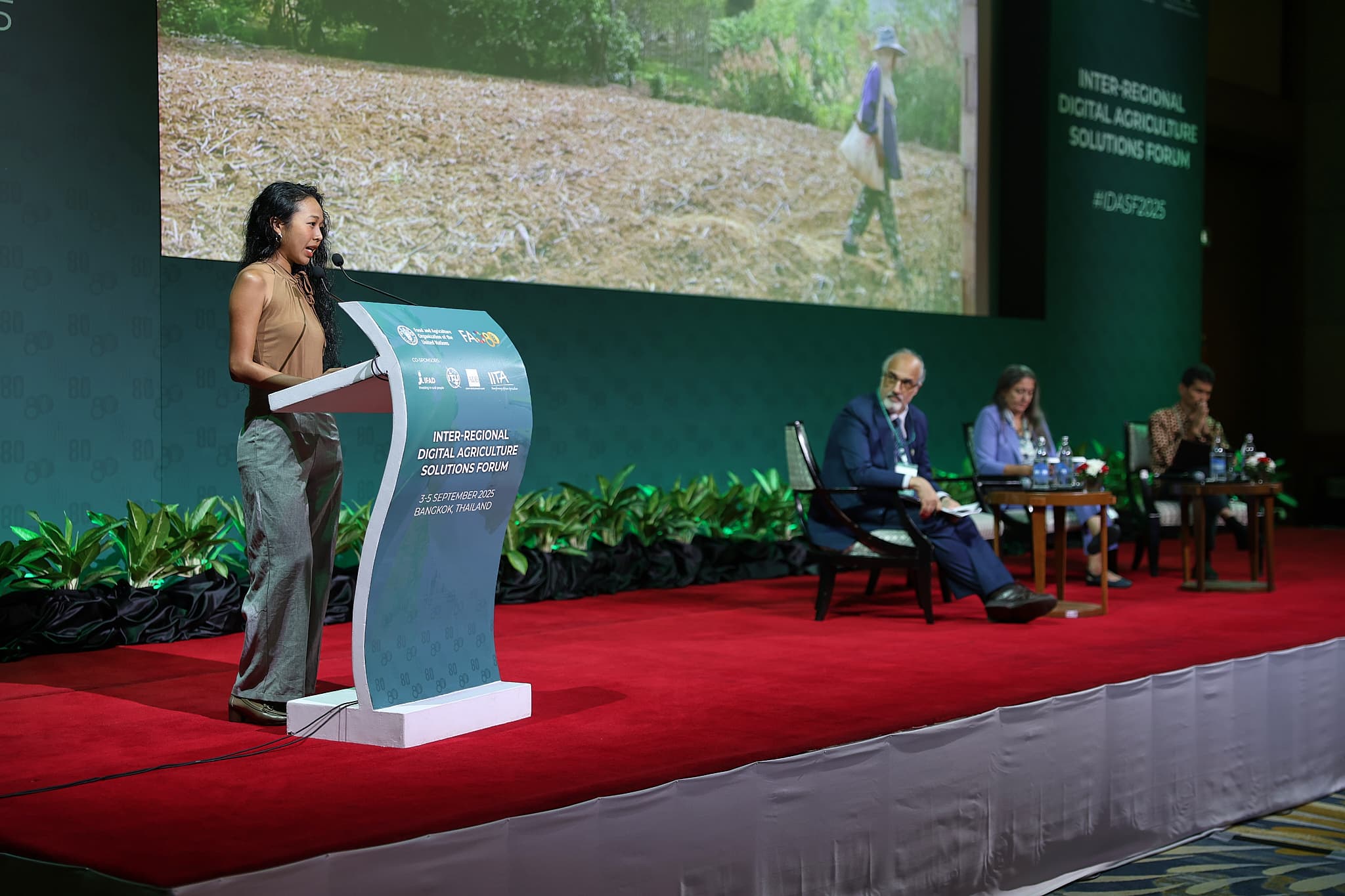
At the FAO[1]Link to footnote Inter-regional Digital Agriculture Solutions Forum (IDASF) in Bangkok on 3–5 September 2025, co-sponsored by ADB, IFAD, ITU, and CGIAR-IITA, we observed a consensus that digital tools are essential enablers of resilient agrifood systems, paired with a frank assessment that most deployments still fail equitable scaling tests. The forum positioned digital agriculture not as a technology showcase but as a structural partnership challenge spanning public agencies, development finance, academia, and venture-backed innovation.
Lesly Goh, presenting the Southeast Asia Innovation Alliance for a Global Model of Agri-Food Systems (SIGMA), co-led by the University of Illinois and the National University of Singapore, outlined how advanced sensing and modelling can digitally capture plant-growing systems, beginning with rice. The SIGMA team's SYMFONI platform combines process-based crop modelling, localised ground data, satellite remote sensing, and AI-enabled model-data fusion to deliver low-cost, high-integrity carbon and methane tracking without manual data-entry burdens that exclude smallholders.
For climate-tech operators, the IDASF message was direct: inclusive AI platforms demand structural partnerships, not standalone product launches.
Gender, tenure, and connectivity barriers
Standard Western MRV systems require manual, data-heavy reporting that is cost-prohibitive and overly complex for smallholder-dominated landscapes. When platforms ignore structural barriers, localised land-tenure patterns, rural connectivity deficits, gendered divisions of agricultural labour, they inadvertently lock out the producers who most need climate resilience and transition-finance access.
Gender inclusion
Who can actually use the platform?
Tenure + connectivity
What the system assumes
Gender dimensions are not ancillary. Women perform critical roles in rice cultivation, post-harvest processing, and household food security across Southeast Asia, yet digital extension and MRV interfaces often default to male land-title holders and smartphone-equipped farm managers. Land tenure fragmentation means satellite-verified practices may not map to the individuals making irrigation decisions. Rural connectivity gaps render cloud-first architectures unusable during peak agricultural seasons.
True systems-level change happens when venture-backed agile innovation meets robust public-private frameworks, with explicit design for gender inclusion, tenure complexity, and offline-capable workflows.
Impact Intelligence Lab's work on spatial intelligence must therefore anchor in human geography: who farms, who decides, who benefits from verified emission reductions.
MRV and smallholder transition finance
SIGMA is launching SYMFONI's first real-world pilot in Vietnam's Mekong Delta, building on the World Bank-supported Vietnam Sustainable Agriculture Transformation Project (VNSAT), which cultivated 180,000 hectares of low-emission rice and increased farmer profits by 30–35%. The Vietnamese government is scaling toward one million hectares of high-quality, low-emission rice, targeting up to 70% methane reduction. SYMFONI integration is designed to verify those reductions for carbon markets and international price premiums.
VNSAT scale-up: hectares, profit, methane
- Low-emission rice (thousand ha)180k ha1M ha
- Farmer profit change (%)baseline+30–35%
- Methane reduction (%), up to 70%
This is the operational model IDASF championed: satellite-based MRV fused with process models and minimal ground truth, unlocking transition finance for smallholders who cannot complete spreadsheet audits. Operators should treat MRV as a financial-inclusion instrument, not only a compliance instrument. Verified low-emission practices must connect to payment mechanisms, premium offtake, carbon credits, climate-smart subsidies, that reach plot level despite tenure complexity.
Low-burden verification
Fuse satellite observation, process models, and limited ground truth to avoid spreadsheet workflows that exclude smallholders.
Finance linkage
Treat MRV as a financial inclusion mechanism: verified practices should map to payments, premiums, and credits despite tenure complexity.
Offline-aware operations
Design around seasonal connectivity constraints so verification and data capture survive real farming conditions.
- 1.FAO