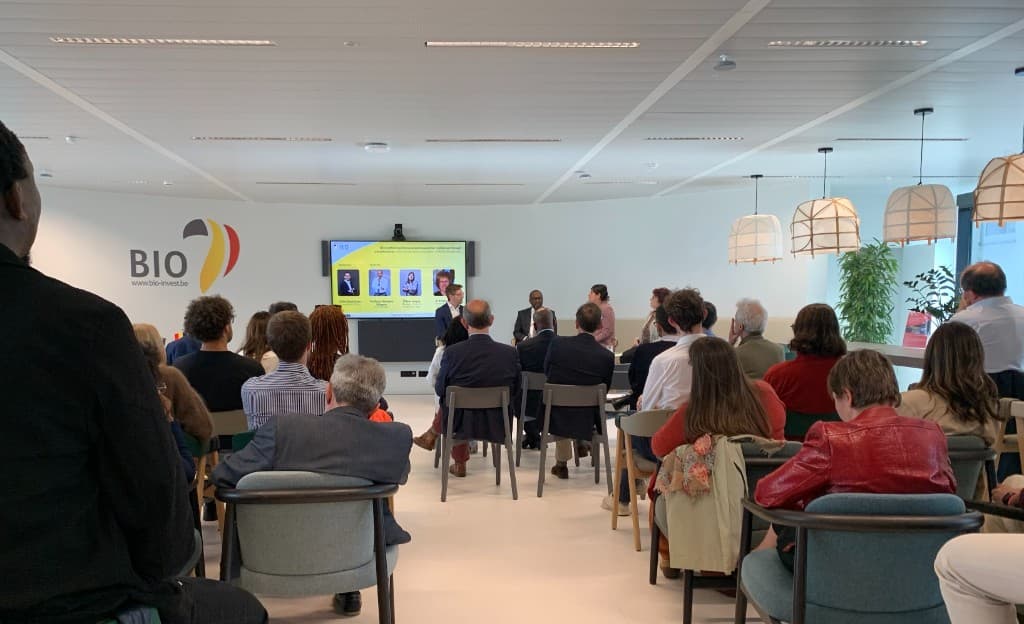
The signing table at BIO
We attended the Belgian Investment Company for Developing Countries (BIO) event at its Brussels headquarters on 21 May 2026 on the question: How can microfinance increase financial and economic resilience in high-risk environments?[1]Link to footnote[2]Link to footnote The programme bridged a framing keynote, a practitioner–DFI–academic panel debate, and a signing ceremony for BIO's first investment in a Congolese microfinance institution, a USD 5 million loan to Société de Microcrédits Congolais (SMICO).[3]Link to footnote[4]Link to footnote[5]Link to footnote
The loan is guaranteed by EDFI Management Company (EDFI MC) under the EDFI MSME Platform, backed by 50% portfolio risk cover funded through the EU's EFSD+ framework.[6]Link to footnote SMICO serves more than 82,000 clients across eight provinces through ten branches; the investment supports portfolio expansion beyond conflict-affected Kivu, with explicit targeting of women and youth micro-entrepreneurs.[6]Link to footnote[7]Link to footnote The event aligned with BIO's 2024–2028 Investment Strategy, EUR 1.2 billion over five years, 45% of new volume to Africa, 30% to LDCs and fragile and conflict-affected states (FCAS)[8]Link to footnote, while discussions acknowledged that credit alone cannot substitute for robust institutions, security, and complementary social protection.[9]Link to footnote[10]Link to footnote[11]Link to footnote
This briefing analyses the Brussels event, the SMICO transaction, and the blended-finance architecture behind it.
Microfinance can help low-income households absorb shocks and rebuild assets, but resilience is multi-dimensional, requiring complementary investments in human capital, climate adaptation, and local governance. Credit plays a supportive, not standalone, role in fragile states.
Event themes and sessions
The programme bridged a framing keynote, a practitioner–DFI–academic panel debate, and a dedicated SMICO investment signing ceremony, anchoring theoretical resilience debates in a concrete transaction.[2]Link to footnote[4]Link to footnote
Event programme structure
21 May 2026, BIO headquarters, Brussels
Core thematic clusters
The deliberations at the event reveal four dominant thematic clusters governing microfinance resilience in conflict-affected frontier markets.
Operational continuity
Conflict mitigation and geographic diversification
Blended finance architecture
Risk-sharing and capital mobilisation
Dual-mission and social performance
Financial sustainability versus deep outreach
Digital financial services
Scaling versus fragility trade-offs
Prominent speakers and key messages
Prominent speakers and key messages
Panel debate and signing ceremony, 21 May 2026
Operational continuity and conflict mitigation
The primary session addressed how microfinance institutions maintain operational continuity when operating in active conflict zones. SMICO operates ten branches across eight provinces, with a workforce of approximately 100–102 employees, granting loans via individual and group methodologies.[12]Link to footnote[13]Link to footnote At end-2021, SMICO held roughly USD 15 million in client savings and USD 14.3 million in outstanding loans, largely concentrated in the Kivu region.[13]Link to footnote[14]Link to footnote
In early 2025, the seizure of Goma and Bukavu by AFC/M23 rebels forced SMICO to suspend banking activities at these branches. Operations in Uvira remained dependent on the local security situation. SMICO recorded a net loss of 1.29 billion Congolese francs (CDF) in the first half of 2025.[7]Link to footnote
Pacifique Ndagano detailed a geographic diversification strategy designed to counter localized conflict risks. SMICO framed the loan primarily as growth capital, expanding into Isiro (Haut-Uele) and Butembo (North Kivu) while consolidating networks in Lubumbashi, Kolwezi, Kisangani, Likasi, Bunia, Kalemie, and Kindu, with a 2030 strategy to reach central and western provinces.[7]Link to footnote SMICO also maintains a presence in Goma, Bukavu, and Uvira, pending security stabilisation.
High-risk eastern footprint
Diversification targets
Risk-sharing and blended finance architectures
Traditional bilateral lending is insufficient to bridge financing gaps in Least Developed Countries without robust risk-sharing mechanisms.[6]Link to footnote The BIO-SMICO transaction serves as an exemplary blended finance architecture.
BIO-SMICO blended finance stack
Capital flow from EU guarantee facility to Congolese MFI
Milena Loayza situated the SMICO investment within BIO's broader financial inclusion strategy, which prioritises banks, MFIs, fintechs, and insurance companies as vehicles to reach MSMEs and vulnerable households.[15]Link to footnote She highlighted that DFIs can catalyse private capital through blended finance structures but must avoid long-term market distortion and maintain strong ESG standards.[8]Link to footnote
Microfinance commercialization and the dual-mission
The panel addressed a long-standing debate in development economics: whether commercialization of MFIs inevitably leads to "mission drift", the abandonment of the poorest clients, particularly women, in pursuit of profitability.[10]Link to footnote
Dr. Ariane Szafarz drew on CERMi research on microfinance governance, mission drift, and gender discrimination in credit markets to caution against oversimplifying resilience claims.[16]Link to footnote[17]Link to footnote She noted that MFIs in fragile contexts face liquidity, credit, and operational risks that can undermine both financial sustainability and social mission if not carefully managed.[17]Link to footnote
Szafarz underscored that social screening and outreach to vulnerable segments can be costly but are central to resilience-oriented microfinance. SMICO's average loan size of approximately USD 5,000, with 40% of portfolio in group-based loans, reflects a cross-subsidisation model rather than pure commercial drift, though the boundary remains thin.[5]Link to footnote BIO's investment requires strict 2X Challenge accountability: female board representation at 43%, workforce share at 38% (target 40% by 2027), and female borrowers at 32% (commitment to 51% by 2027).[5]Link to footnote
SMICO gender and inclusion targets (2025 baseline → 2027)
Digital financial services and socio-financial trade-offs
Digital channels are indispensable for scaling operations in vast, infrastructure-poor nations like the DRC.[7]Link to footnote SMICO's expansion strategy combines branch openings, banking agent and super-agent networks, and digital channels including mobile and web banking, projected to grow the active client base from 74,000 to 113,000 by 2027, while the total customer base already exceeds 92,000.[5]Link to footnote[7]Link to footnote
Milena Loayza cautioned that while digitisation can improve operational efficiency, MFIs in FCAS must maintain proximity-based service models and flexible products tailored to irregular cash flows, and avoid market distortion from rushed digital rollouts without operational fundamentals.[15]Link to footnote
Digital efficiency gains
Fragile-state constraints
SMICO active client base projection
Policy and strategic context
BIO's 2024–2028 mandate and Belgian development finance
BIO is a public development finance institution fully owned by the Belgian State, overseen by the Ministry for Development Cooperation, with mandates referencing climate, gender, and fragile states priorities.[18]Link to footnote[19]Link to footnote Its 2024–2028 Investment Strategy commits to intensifying impact in Africa, LDCs, and FCAS through financial institutions (including microfinance), agri-value chains, and renewable energy.[8]Link to footnote
BIO 2024–2028 strategic investment targets
European development finance, Global Gateway and EFSD+
European DFIs operate within the Global Gateway initiative and the EFSD+ framework, the financing arm providing guarantees and blended finance for partner country investments.[20]Link to footnote[21]Link to footnote
EU policy on peace, security, and resilience emphasises a shift from crisis containment toward upstream measures addressing underlying vulnerabilities, with inclusive finance seen as a tool to bolster household and community resilience when integrated with humanitarian, climate, and governance interventions.[22]Link to footnote[9]Link to footnote
Implications for Asian financial inclusion policy
Asian science policy, notably India's Unified Payments Interface (UPI), has long prioritised high-volume, low-cost digital transaction rails. However, rapid commercial credit expansion without adequate client education can lead to over-indebtedness crises, as demonstrated in regions like Andhra Pradesh.[23]Link to footnote Asian regulators may draw lessons from BIO's guarantee-based de-risking model and SMICO's combined focus on women and youth targeting.
Comparative policy frameworks, EU vs Asian regional models
| Microfinance policy architecture | ||
|---|---|---|
| European UnionEFSD+ / Global Gateway | Asian regional frameworkDPI / Digital India | |
| Primary mechanism | Public risk-sharing guarantees to mobilize private development debt into fragile states | Government-funded open-source digital public infrastructures to lower transactional friction |
| Operational priority | Enforcing strict ESG, gender equity (2X Challenge), and client protection pathways | Scaling rapid digital payment adoption, agent banking networks, and fintech integration |
| Systemic risk mitigation | External multilateral guarantee facilities to de-risk sovereign and transfer volatility | Credit registries, consumer protection laws, and financial literacy programs |
| Strategic focus | Capacity-building of local financial intermediaries through patient capital and technical assistance | Direct integration of micro-entrepreneurs into national digital taxation and formal banking systems |
Stakeholder perspectives
The event revealed distinct, yet complementary, strategic priorities among stakeholder groups, with civil-society critiques of DFI transparency adding an accountability dimension to the discussions.[24]Link to footnote
Development finance institutions
BIO and EDFI MC
Local MFI practitioners
SMICO leadership
Academic researchers
CERMi / ULB
Media and civil society
L'Echo / 11.11.11
Beneficiaries, women and youth micro-entrepreneurs, small agriculturalists, and informal traders, were central to the discussion.[7]Link to footnote For these individuals, microfinance provides liquidity to manage household instability, finance healthcare and education, and protect livelihoods against economic and security shocks.[25]Link to footnote
Critical analysis
Strengths of the event framing
The event effectively bridged practice, investment, and research, anchoring resilience theory in the concrete SMICO case and linking it to BIO's strategic framework and European policies.[8]Link to footnote Discussions drew on established frameworks including the European Microfinance Award dialogues and CGAP's work on inclusive finance in fragile countries, grounding the resilience narrative in empirical evidence.[9]Link to footnote[10]Link to footnote
Gaps and unresolved questions
Unresolved strategic questions
Critical gaps remaining after panel debates
Tensions and contradictions
A central tension lies between scaling microfinance in FCAS and protecting clients from over-indebtedness and MFIs from mission drift, especially under pressure to achieve financial returns and portfolio growth.[10]Link to footnote There is also a potential contradiction between DFIs' strategic focus on high-risk areas and risk-averse capital allocation targets.[24]Link to footnote Civil-society critiques of BIO's transparency and impact evaluation practices suggest external stakeholders remain concerned about accountability and alignment with Belgian development cooperation goals.[24]Link to footnote[19]Link to footnote
Forward-looking assessment
Likely developments (2026–2029)
Over the next one to three years, BIO's strategy and the SMICO investment indicate deeper engagement in FCAS through financial institutions, supported by European guarantees and blended finance. Similar transactions in other African FCAS and LDCs are likely as DFIs replicate risk-sharing structures with local MFIs.[8]Link to footnote[20]Link to footnote
Academic and policy debates on resilience, inclusive finance, and climate adaptation in fragile settings are expected to intensify, potentially leading to more sophisticated impact measurement and cross-sector initiatives combining microfinance, cash transfers, insurance, and climate-resilient agriculture.[26]Link to footnote[22]Link to footnote
Recommended areas for further investigation
- Risk-sharing architectures in FCAS: Detailed analysis of guarantee structures, currency-hedging mechanisms, and contingency planning in DFI–MFI partnerships.[20]Link to footnote
- Resilience impact measurement: Metrics capturing household asset trajectories, income diversification, shock response, and wellbeing beyond traditional financial indicators.[9]Link to footnote[10]Link to footnote
- Gender and youth dynamics: Studies on intra-household power relations and entrepreneurship pathways in FCAS.[26]Link to footnote
- Integration with humanitarian and climate finance: Models combining microfinance with cash transfers, climate adaptation, and social protection.[26]Link to footnote[9]Link to footnote
- Governance and accountability of DFIs: Transparency, impact evaluation, and participatory governance in institutions like BIO.[24]Link to footnote[19]Link to footnote
Appendix: selected data points and commitments
SMICO performance covenants and strategic targets
| Operational metric | Baseline (2025–2026) | Target (2027–2030) | |
|---|---|---|---|
| Financial performance | Net result | Net loss of 1.29B CDF (H1 2025) | Portfolio recovery via geographic diversification |
| Client reach | Active / total clients | 74,000 active · 82,000+ served · 92,000+ total customers | 113,000 active clients by end of 2027 |
| Gender, borrowers (2X) | Female borrower ratio | 32% | 51% by end of 2027 |
| Gender, governance (2X) | Female board representation | 43% | Maintain ≥40% female share |
| Gender, workforce (2X) | Female employment share | 38% | 40% by 2027 |
| Eastern branches | Goma & Bukavu status | Suspended, AFC/M23 conflict (early 2025) | Re-open pending regional security stabilisation |
| Geographic expansion | Footprint | Ten branches across eight provinces | Isiro, Butembo, and western provinces by 2030 |
| Target beneficiaries | Client profile | Micro-entrepreneurs in eastern DRC | Women and youth micro-entrepreneurs nationwide |
- 1.Strengthening financial inclusion in the DRC through EDFI MC-supported BIO investment
- 2.BIO, Meet the speakers (LinkedIn)
- 3.SMICO secures $5 million from Belgium's BIO
- 4.BIO, How can microfinance increase resilience? (LinkedIn), https://www.linkedin.com/posts/bio-belgian-investment-company-for-developing-countries_%F0%9D%97%9B%F0%9D%97%BC%F0%9D%98%84%F0%9D%97%B0%F0%9D%97%AE%F0%9D%97%BF-%F0%9D%97%BA%F0%9D%97%B6-activity-7457687124247691266-UEEb
- 5.Société de Microcrédits Congolais, BIO invests
- 6.Strengthening financial inclusion in the DRC, EDFI MC
- 7.SMICO secures $5 million from Belgium's BIO, Bankable Africa
- 8.[PDF] Investment Strategy 2024–2028, BIO invests
- 9.From Crisis to Resilience: The Role of Inclusive Finance in Fragile Countries, CGAP
- 10.Microfinance in Post-disaster, Post-conflict Areas & Fragile States, FinDev Gateway
- 11.BIO Invests $5m in Congolese Microfinance Institution SMICO, Africa Global Funds
- 12.[PDF] Improving the Offer of Financial and Non-Financial Services, SMICO
- 13.Smico SA, Fondation Grameen Crédit-Agricole
- 14.SMICO SA
- 15.Financial institutions, Annual report, BIO invests
- 16.SZAFARZ Ariane, CERMi
- 17.Centre for European Research in Microfinance (CERMi), ULB
- 18.BIO: a paragon of impact finance, FPS Foreign Affairs
- 19.Work to be done for the Belgian Development Bank (BIO), 11.11.11
- 20.European Fund for Sustainable Development Plus, European Commission
- 21.Global Gateway overview, International Partnerships
- 22.Peace and security, International Partnerships
- 23.Determinants of Transformation and Commercialization of MFIs
- 24.Work to be done for the Belgian Development Bank (BIO), 11.11.11
- 25.I want to be close to the people who need me, BIO Invest
- 26.Addressing climate change adaptation in fragile settings, Adaptation Fund