Executive summary
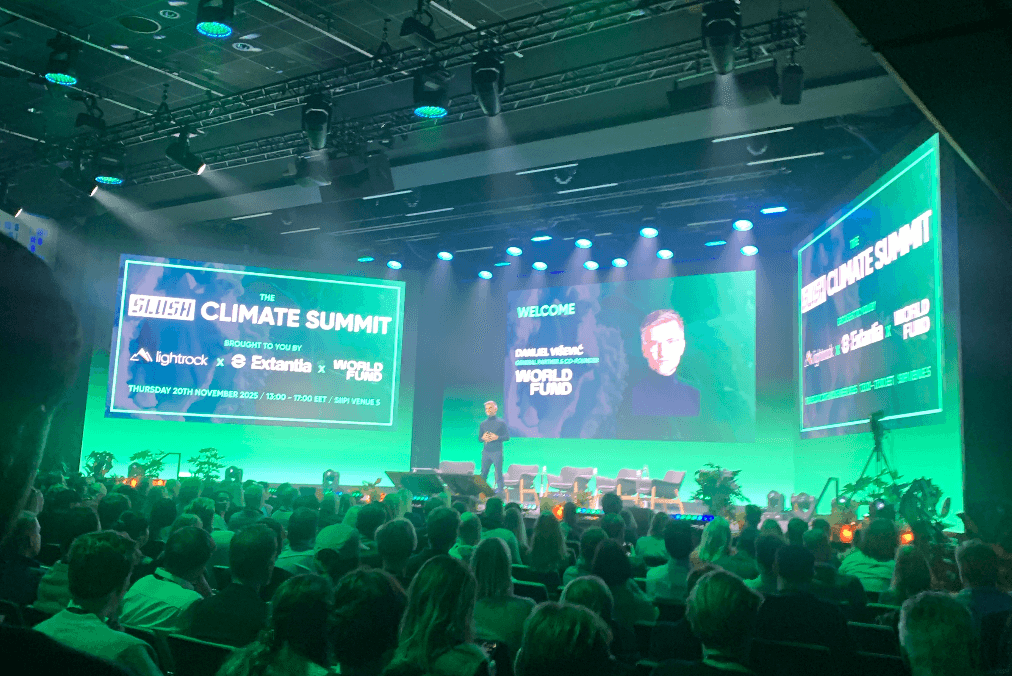
We attended the Slush Climate Summit[1]Link to footnote at the Helsinki Expo and Convention Centre (Messukeskus) on 20 November 2025, hosted by Lightrock, Extantia[26]Link to footnote, and World Fund as the sustainability-focused side event of the main Slush conference[24]Link to footnote. Against tighter liquidity, panels centred on a structural shift from narrative-driven sustainability valuations toward metric-centric commercial execution, prioritising unit economics, capital efficiency, and paths to profitability over environmental narrative alone.[12]Link to footnote
Key discussions treated artificial intelligence as both an R&D accelerator and a major source of energy demand requiring infrastructure-level cleantech solutions. Global industrial dynamics, particularly Chinese manufacturing execution, were framed as forcing hybrid models that integrate European research with global production chains. Late-stage vehicles such as Eurazeo's €500 million Future Industries Fund aim to bridge early venture capital and asset-heavy industrial expansion.
This briefing synthesises what we heard at Messukeskus, technology trends, investment landscapes, regulatory dynamics, and strategic priorities for the European cleantech ecosystem.
Conference overview and structural parameters
The Slush Climate Summit operates as a highly curated platform within the broader Slush ecosystem, matching scalable climate technologies with private and institutional capital.[5]Link to footnote The main Slush event attracted approximately 13,000 attendees, including more than 6,000 startup founders and 3,500 venture capital investors collectively managing over $4 trillion in assets under management.
The main conference was surrounded by a network of specialised side events expanding discussions beyond the main stage.[2]Link to footnote
Slush Climate Summit side events
Specialised programmes beyond the main stage
Dominant thematic paradigms
The summit's panels and sessions reflected a shift away from general sustainability narratives and toward capital efficiency and commercial competitiveness, driven by tighter macroeconomic conditions and higher borrowing costs that force both investors and founders to prioritise near-term financial viability.
The decarbonisation of the green premium
A central theme was the need to design cleantech products that compete directly on price with fossil-fuel alternatives, rather than relying on customers' willingness to pay a sustainability premium.[21]Link to footnote Investors noted that the market has evolved past the point where a strong environmental narrative alone can secure funding.
This shift has led to the exit of speculative capital, described during panels as "tourist capital". In its place, active fund managers are conducting more rigorous, metric-driven assessments that prioritise unit economics, capital efficiency, and a clear path to profitability from the early stages of development.
The intersection of artificial intelligence and climate
The relationship between artificial intelligence and climate change was analysed through two distinct lenses:
- AI as an accelerator: Artificial intelligence serves as a critical tool for climate solutions, speeding up materials science research, crop diagnostics, and hardware optimisations through high-speed computer modelling that bypasses slow physical testing loops.
- AI as an energy liability: The high energy consumption of hyperscale data centres is driving significant demand for climate tech. As trillions of dollars flow into AI infrastructure, a major opportunity has emerged for cleantech companies to supply decentralised clean energy, energy-efficient chips, and advanced cooling systems.
Industrial scale-up and sovereignty
Panelists contrasted Europe's academic and research strengths with China's rapid manufacturing execution and industrial capacity. Participants warned that Europe risks acting as an "R&D department" that designs innovative technologies but loses the commercial manufacturing and economic benefits to foreign markets.
To address this execution gap, speakers discussed hybrid models where European startups retain core intellectual property and software design locally while partnering with international manufacturing hubs to scale production quickly and cost-effectively.
Impact measurement and management
The summit featured discussions on the evolution of ESG metrics from simple compliance checklists to quantitative, auditable systems. Panelists emphasised that early-stage cleantech companies must build robust measurement frameworks into their core product design to meet the standards of institutional investors and enterprise buyers, increasingly seen as a commercial asset that helps startups secure customers and access institutional capital aligned with the SFDR Article 8 framework.
Notable speakers and keynote proceedings
The summit featured presentations from founders, venture capital partners, and industry experts focused on the operational realities of building and financing hardware-based clean technologies in a challenging market environment.
The Climatetech Playbook panel
Moderated by Akansha Dimri, Founder and Editor-in-Chief of Tech Funding News[16]Link to footnote[14]Link to footnote[11]Link to footnote[8]Link to footnote[7]Link to footnote[4]Link to footnote[3]Link to footnote, this panel brought together leading European investors to discuss changing market dynamics and underwriting strategies.
The Climatetech Playbook panel
European investors on underwriting and execution
The Green Growth Playbook and special presentations
The summit also featured targeted presentations and fireside chats focused on specific scaling and operational strategies.
Summit sessions and keynotes
Scaling strategies and commercial frameworks
Voltrac fireside chat: autonomous hardware and dual-use logistics
Akansha Dimri hosted a fireside chat with Tom Hubregtsen, Co-founder and CEO of Valencia-based Voltrac[13]Link to footnote, focusing on the company's autonomous electric vehicle platform and its application across multiple sectors.
- Modular system design and reliability: Voltrac's heavy-duty autonomous electric tractor is designed with 70% fewer moving parts than traditional agricultural machinery. During testing in Spanish vineyards, the tractor demonstrated resilience by disabling a damaged motor and continuing to operate on 75% of its remaining propulsion, avoiding the costly field downtime common with complex machinery.
- Dual-use commercial strategy: While designed primarily for agricultural tasks like labour-intensive vineyard cultivation, the platform is also being developed for defence logistics. Voltrac is currently focusing 80% of its resources on agriculture and 20% on defence logistics for NATO countries. The company raised €7 million ahead of the summit.
- Precision agriculture data platform: The vehicle functions as an active data-gathering platform, using sensors and AI-ready GPUs to perform daily, plant-level crop analysis. By feeding health data back into reinforcement learning models, the system enables precise application of fertilisers and chemicals, which can triple farmers' margins once fully implemented.
Scaling climate deep tech in emerging Asia
A quieter but telling counterpoint to the main-stage investor panels unfolded at The Topelius Cabinet, an Earth VC side event titled Scaling Climate Deep Tech: From The World To Emerging Asia. Read as a manifesto as much as a programme, it called for climate deep tech to stop treating "Asia" as an abstract market and start grappling with it as a messy, political, and opportunity-dense reality.
Event framing: the subtext behind the title
The headline, Scaling Climate Deep Tech: From The World To Emerging Asia, signals a one-way trajectory: solutions conceived elsewhere, landing in Asian markets. It is a revealing choice. It acknowledges that much of climate deep tech is still architected in Europe and the US, while framing Asia primarily as a destination for scale rather than a source of original innovation.
Held in Helsinki as a Slush 2025 side event, the geography itself is symbolic: conversations about Asia's climate future are happening in Nordic rooms, mediated by global capital. That is not inherently problematic, but it does foreground the central tension of the session: can you genuinely talk about "emerging Asia" from a European vantage point without reproducing a familiar extractive pattern?
Three pillars, one underlying problem
Earth VC structured the conversation around three founder pain points: market entry, strategic partnerships, and fundraising.
- Market entry was framed as adapting product-market fit to Asia's "unique contexts", energy transition, blue economy, regulatory patchwork. The language is correct but generic; it hints at complexity without naming specific political economies (e.g., Thailand's PDP, Vietnam's PDP8, Indonesia's nickel-driven industrial policy) where climate deep tech either collides with incumbents or gets weaponized for greenwashing.
- Strategic partnerships were described as leveraging corporates, governments, and ecosystem builders as "scale partners" to overcome barriers. The phrase "scale partners" is doing a lot of work here. It suggests founders should plug into existing power structures, but it sidesteps the core question: which corporates and governments are genuinely climate-aligned, and which are using deep tech as a PR layer over fossil-centric growth?
- Fundraising was framed around mobilizing global capital while aligning with local realities. This is the most honest line in the description: climate deep tech is still largely dependent on Northern capital, yet expected to deliver impact in Southern geographies where political risk, currency risk, and governance gaps are not bugs but features of the landscape.
Collectively, these pillars sketch a familiar narrative: climate deep tech is a technical solution seeking markets; Asia is a complex but lucrative frontier; capital is global, implementation is local. The more uncomfortable reality, that deep tech itself can entrench inequities if it scales atop existing extractive systems, is left between the lines.
Asia as climate frontier: opportunity vs. power
The event copy described Asia as both a region "facing pressing climate challenges" and offering "massive opportunities." This duality is at the heart of current climate-tech discourse.
On one hand, Asia is where sea-level rise, heat stress, and food system volatility converge into existential risk, particularly for smallholders and informal urban communities. On the other, it is where industrial decarbonization, grid modernization, and blue economy plays can unlock not millions, but billions, in climate finance.
The description mentioned energy transition and blue economy, but not land rights, labor, or governance. Yet those are precisely the variables that determine whether a robotics firm in coastal monitoring, an AI platform for renewable siting, or an MRV stack for carbon projects becomes a tool for resilience, or a tool for control.
Without that lens, "emerging Asia" risks being treated as a sandbox for Northern technologies: a place to prove unit economics and impact metrics, then export the success story back to investors in Helsinki, London, or San Francisco.
Founders' lived experience: the missing specifics
Earth VC promised the session would be "grounded in the lived experiences of 4 global founders now actually scaling in Asia," highlighting Sidhant Gupta of Clear Robotics. This is the right instinct: climate deep tech in Asia is not a theory; it is a series of decisions about pilots, policy, and power brokers.
The absence of detail in the public description, sectors, countries, failure stories, is a missed opportunity. The founders in the room almost certainly have hard stories: stalled MOUs with ministries, projects delayed by land conflicts, pilots reshaped to satisfy state-owned utilities. These are the real curriculum of "scaling deep tech in Asia," and the fact that they are not hinted at in the event copy suggests that the on-site conversation will need to do more work than the marketing lets on.
If the session stays at the level of generic "partnerships" and "capital alignment," it will replicate a pattern many climate founders know too well: panels that coach founders to be legible to investors, not necessarily accountable to communities.
What this signals about Earth VC and the ecosystem
For Earth VC, this side event is a positioning move: "Building climate tech that can scale globally?" appears as the closing call-to-action on the page. It situates the fund explicitly as a bridge between global climate deep tech and Asian markets, not just as capital, but as a translator of context.[20]Link to footnote
The sharper question is: translator for whom?
If the emphasis remains on founders and investors, Asia risks being reduced to a set of constraints to be navigated and a set of metrics to be harvested. If the emphasis extends to frontline actors, local cooperatives, civil-society watchdogs, municipal planners, then "scaling from the world to emerging Asia" could evolve into "co-creating with Asia for a world in climate crisis."
Either way, this Slush side event is a micro-signal in a larger trend: climate deep tech is consolidating around a storyline where emerging Asia is a non-negotiable theater of operations, but the terms of engagement are still largely written elsewhere. For founders and operators in the region, the most productive stance may be to treat the room as a negotiation table: not just on how to enter Asian markets, but on how to redistribute agency in who defines "impact" and who owns the hardware, data, and infrastructures that deep tech leaves behind.
Deep-tech and hardware technology trends
The summit highlighted technologies that combine decarbonisation with immediate operational benefits, cost reduction, labour savings, or increased resource resilience.
Autonomous electric mobility and robotics
Autonomous electric vehicles are moving from pilot phases to active industrial deployment, particularly in labour-constrained sectors like agriculture. Companies like Voltrac are leading this trend with modular, software-defined electric utility platforms that prioritise hardware simplification, reducing moving parts to improve reliability and repairability in challenging field environments.
When one of four independent electric motors is disabled, the platform retains 75% of its operational propulsion, allowing the vehicle to drive out of the field on its own power. The integration of on-board AI-ready GPUs enables real-time crop analysis, shifting agricultural management from annual assessments to daily, plant-level monitoring.
Green computing and thermal systems
The high energy demands of generative AI models have accelerated the development of green computing technologies. Key innovation areas include advanced cooling solutions and software-driven energy orchestration for data centres. European green-supercomputing exemplars such as LUMI, renewable-powered, liquid-cooled, with waste-heat recovery, set a reference architecture.
Companies like Diamond Foundry are developing advanced materials, such as single-crystal diamond substrates, to handle the high heat density of modern processors. Similarly, Monumo is using deep-tech modelling to optimise the design and efficiency of electric drive units, reducing energy losses in electric vehicle motors.
For any digital platform claiming climate impact, hardware-level integrity and verifiable energy provenance are now investor diligence items, not optional sustainability reporting.
Circular food systems and agrifood resilience
The Futures of Food side event, co-organised by EIT Food[9]Link to footnote and the University of Helsinki, showcased early-stage startups focused on resource efficiency and climate resilience.
Climate-resilient agriculture
Warsaw Hub Cohort startups
Circular food technologies
Helsinki Hub Cohort startups
Building decarbonisation and energy SaaS
In the built environment, startups are combining software with physical installation to improve energy efficiency. VARM secured €5.7 million in seed funding to scale its home insulation services across Europe. In the commercial sector, Aedifion raised a €20 million Series B round for its cloud-based SaaS platform, which monitors and optimises energy use in large building portfolios.[22]Link to footnote
Event-level decarbonisation and carbon sequestration
The main Slush conference implemented several "Slushtainability" initiatives to address its operational footprint, which generates approximately 308 metric tons of CO₂ emissions annually.[10]Link to footnote These efforts included partnering with Jylhä Logistics to run transport routes on renewable liquefied biogas (LBG), reducing greenhouse gas emissions by up to 90% compared to fossil fuels.
To offset remaining emissions, the event supported the Slush Forest program, a land-conservation initiative run in partnership with the Finnish Natural Heritage Foundation that permanently protects 51 hectares of endangered forest across three sites in Finland.
Slush Forest annual CO₂ sequestration by site
Together, these areas sequester 133.4 metric tons of CO₂ equivalent annually, offsetting approximately 43.3% of the event's operational footprint, with plans to expand protected areas to reach 100% net neutrality.
Venture capital and asset financing landscape
The investment landscape discussed at the summit reflects a transition from early-stage venture capital models toward institutional frameworks structured to support physical asset deployment and scale-up.
Late-stage venture and growth equity funds
A key challenge for capital-intensive cleantech startups is the lack of growth capital to transition from demonstration projects to commercial-scale manufacturing. Traditional venture capital is often a poor fit for asset-heavy businesses with long development timelines. European investment groups are launching funds tailored to these challenges:
The Eurazeo fund acts as a bridge between late-stage venture and early growth equity, prioritising structured pricing, milestone-linked investments, and clear exit valuations linked to operational cash flow rather than speculative valuation mark-ups.
Startup performance pressures
The Slush Startup Struggle Survey[6]Link to footnote, which gathered insights from 607 early-stage European founders, highlighted a more challenging and disciplined fundraising environment:
This quantitative data shows that investors are prioritising operational efficiency and commercial metrics over long-term technological projections. Cleantech founders must demonstrate customer offtake agreements and reliable supply chains to secure growth capital.
Policy frameworks and regulatory dynamics
European regulations are increasingly seen as a strategic driver of market demand and product development, rather than just a compliance requirement.
Regulation as a competitive advantage
Compliance with frameworks like GDPR and the EU AI Act is helping startups build trust with risk-averse institutional customers. Founders who integrate compliance, data ethics, and auditability into their product architecture can speed up sales cycles, particularly when selling to public sector bodies and enterprise buyers. Funds like Eurazeo are using the SFDR Article 8 framework to attract sustainability-focused institutional limited partners, turning regulatory compliance into a fundraising advantage.
Lobbying for pension fund integration
A major policy initiative discussed at the summit was Slush's submission of 10 reform proposals to Finnish Prime Minister Petteri Orpo.[25]Link to footnote Chief among these is a proposal to channel domestic pension fund and public sector assets into private equity and venture capital funds, modelled on the United Kingdom's Mansion House Compact, which aims to unlock large pools of institutional capital to support local growth-stage companies and deep-tech innovation.
Municipal alignment
The summit's focus on policy aligns with the broader implementation of the Paris Agreement.[18]Link to footnote Municipalities are playing a key role in this transition, the City of Helsinki has updated its carbon-neutral target to 2030, supported by key infrastructure changes like the shutdown of the Hanasaari coal power plant, which reduced the city's total emissions by approximately 20%.
Geographic focus and regional discrepancies
While Slush attracts startups from over 70 countries, more than 80% of its core attendees come from the Nordics, the United Kingdom, the DACH region, France, Benelux, Central and Eastern Europe, and Southern Europe, making it a central hub for European venture activity.[15]Link to footnote
However, the event highlighted challenges within individual European markets, particularly in Finland. Despite Helsinki's reputation as a strong startup hub, a survey of over 300 Finnish founders[17]Link to footnote revealed that 53% are actively considering or planning to relocate their businesses abroad, citing cultural aversion to risk, rigid local taxation systems, and the limited size of the domestic market.
The summit contrasted Europe's position with other major global regions. US venture funds remain a key source of late-stage capital, though European startups must adapt to the high returns and rapid scaling timelines expected by American investors. China's dominance in industrial production, battery manufacturing, and supply chains makes it both a key competitor and a necessary partner for scaling hardware, European startups are increasingly using hybrid strategies that keep core R&D in Europe while collaborating with Chinese partners for manufacturing and production scaling.[23]Link to footnote
Structural barriers and scaling challenges
Building and scaling cleantech companies in Europe involves navigating several structural and operational challenges that surfaced repeatedly across summit sessions.
The late-stage capital deficit
While Europe has a strong network of early-stage venture capital, it faces a shortage of large, late-stage growth capital. Large pools of capital, particularly in European pension funds, remain underutilised due to regulatory limits and risk-averse investment cultures. Without local late-stage funding, high-growth European companies often rely on foreign capital, which can lead to businesses relocating their headquarters to the US or Asian markets.
The scale-up execution gap
Moving a technology from laboratory validation to commercial manufacturing is a major challenge. Traditional venture capital, structured for asset-light software businesses with rapid returns, is often a poor fit for capital-intensive cleantech hardware that requires significant upfront investment in physical plant and equipment. This mismatch can stall clean technologies in the demonstration phase, preventing them from reaching commercial scale.
The customer pricing constraint
The transition to sustainable technologies faces a significant hurdle: customers are increasingly unwilling to pay a "green premium." To drive widespread adoption, cleantech products must achieve price and performance parity with traditional alternatives from the start. Companies that rely solely on an environmental value proposition often struggle to secure large-scale commercial contracts.
Talent acquisition and retention
Cleantech startups face intense competition for technical talent, particularly in artificial intelligence and software engineering. Startups must compete directly with well-funded global tech giants that can offer higher compensation packages, greater stability, and more established career paths. Beyond technical skills, founders also report difficulties finding employees with the resilience and operational adaptability needed to thrive in early-stage, hardware-focused environments.
Strategic takeaways
The discussions at the Slush Climate Summit highlight key priorities and strategies for businesses, investors, and policymakers navigating the European cleantech sector.
For businesses and founders
- Prioritise immediate commercial viability: Startups should focus on unit economics and cost competitiveness from day one, rather than relying on environmental narratives.[19]Link to footnote Products must be positioned to win on price and performance, treating sustainability as an added value rather than the sole selling point.
- Simplify hardware design: Engineering teams should prioritise design simplification, using fewer components and building modular, fault-tolerant systems to improve operational reliability and make repairs easier for customers in the field.
- Incorporate dual-use capabilities: Where applicable, hardware developers should explore dual-use applications, such as adapting commercial agricultural or logistics technologies for defence and public sector needs, opening additional revenue streams and access to non-dilutive government funding.
For institutional investors
- Adopt milestone-linked structured investing: Investors navigating capital-intensive industrial transitions should consider structured funding models. Tranching capital deployments to specific, validated milestones helps mitigate risk while supporting physical asset build-outs.
- Focus on industrial economics over valuation mark-ups: Investment strategies should prioritise sustainable cash flow, clear paths to profitability, and realistic exit multiples over paper valuation increases.
- Target clean solutions for digital infrastructure: The rapid growth of AI data centres is driving significant demand for energy and cooling solutions. Investing in high-efficiency hardware, advanced cooling, and decentralised clean energy systems can yield strong returns.
For policymakers
- Unlock long-term institutional capital: Governments can help close the late-stage funding gap by enacting reforms that encourage pension funds and insurance companies to invest a small percentage of their assets in venture capital and growth equity, modelled on initiatives like the UK's Mansion House Compact.
- Streamline procurement and regulatory frameworks: Simplifying public procurement processes can make it easier for state entities to buy from local startups, providing critical early revenue and validation.
- Support international manufacturing alliances: Rather than trying to build entirely isolated domestic supply chains, trade policies should support hybrid models that enable European startups to combine local R&D with global manufacturing partners.
- 1.World Fund
- 2.Side Events - Slush 2026
- 3.Slush Climate Summit reveals what climate investors really want in 2025 [Full Panel Video]
- 4.Eurazeo targets €500M close for its resilient Future Industries Fund - Tech Funding News
- 5.Slush Platform
- 6.Slush 2025 Survey: Startup Struggles Expose Risk, Resilience, and Opportunities for Governance Pros - ComplexDiscovery
- 7.James Cousins, Author at Tech Funding News
- 8.Slush Climate Summit 2025: Voltrac's autonomous EVs are redefining the future of farming and defence [Fireside chat], TFN - Tech Funding News
- 9.Futures of Food: The hottest tech for resilient agriculture and circular food systems
- 10.Several trump cards for Helsinki in the competition between startup cities - Slush brings growth entrepreneurs together again after a year's break
- 11.Expert talk: How Europe's policy landscape shapes EdTech investment, TFN - Tech Funding News
- 12.Tech Talks with TFN - Daniel Secretan, Co Founder, Xapien - YouTube
- 13.Voltrac: Funding, Team & Investors | Startup Intros
- 14.Peter Thiel's VC firm betting big on self-driving tech startup ISEE, leads $40M funding
- 15.Slushtainability - Slush 2026
- 16.This French VC co-founded by female entrepreneur announces first close at €50M
- 17.Finnish Founder Survey Results - Slush
- 18.EK at Slush startup conference: Paris as a Climate Changer - Elinkeinoelämän keskusliitto
- 19.City of Helsinki · Environmental Report 2022 - Helsingin kaupunki
- 20.From Agenda to Action - UN-Habitat
- 21.Sustainability and responsibility at the University of Helsinki in 2023
- 22.Slush Side Event: AI to solve sustainability challenges for better profit
- 23.Startups - Slush 2026
- 24.Slush 2026 | Helsinki, Nov 18-19
- 25.Slush 2026 - European Institute of Innovation & Technology (EIT)
- 26.Extantia | Industries Re-Imagined.