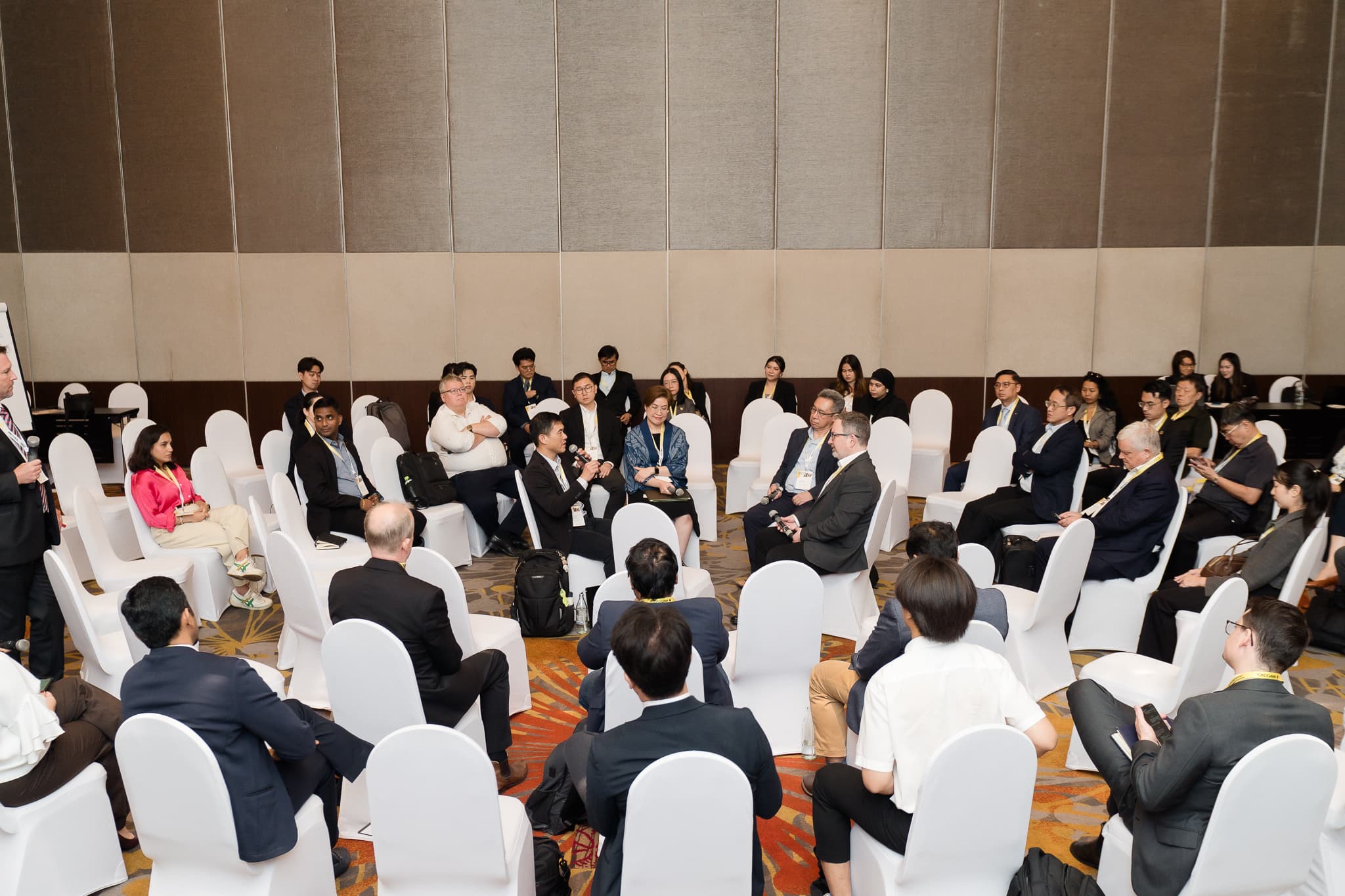
Bangkok, day one of briefings
We attended the Decarbonizing Thailand's High-Emissions Industries Forum in Bangkok, theme Challenges and Opportunities, with technical briefings on 27 January 2026 and the main forum on 28 January 2026. Organised by the Southeast Asia Corporate Decarbonization Exchange (CDx)[3]Link to footnote[1]Link to footnote[11]Link to footnote in partnership with Yokogawa (Thailand) Ltd.[3]Link to footnote, the assembly gathered 100+ delegates with backing from Environment and Climate Change Canada and UNIDO.
Industrial operators at the forum treated decarbonization as a trade-access requirement, not a voluntary corporate goal, driven in part by the European Union's Carbon Border Adjustment Mechanism (CBAM) and the need for verifiable Scope 2 attribution on export-intensive goods.[9]Link to footnote Sessions highlighted thermal energy storage deployment (including SCG and Rondo Energy's Saraburi heat battery), oxyfuel combustion, CCUS pathways, and the data-integrity bottlenecks blocking green-finance access.
This briefing analyses the proceedings, technology trends, investment pathways, regulatory developments, and how regional deployment interfaces with European cleantech developers and policymakers.
Conference overview
The Decarbonizing Thailand's High-Emissions Industries Forum, structured under the official theme Challenges and Opportunities, convened key industrial players and international stakeholders to address the transition of Southeast Asia's most emissions-intensive manufacturing sectors. The forum was held on January 28, 2026, in Bangkok, Thailand, with technical briefings commencing on January 27, 2026.
The assembly was organized by the Southeast Asia Corporate Decarbonization Exchange (CDx)[3]Link to footnote[1]Link to footnote[11]Link to footnote in partnership with Yokogawa (Thailand) Ltd.[3]Link to footnote, serving as a crucial junction for translating corporate climate pledges into localized, verifiable actions. The forum gathered over 100 high-level delegates, comprising national industrial executives, engineering directors, carbon market analysts, non-governmental organizations, and international bilateral development partners. Key strategic and financial backing was provided by Environment and Climate Change Canada (ECCC) and the United Nations Industrial Development Organization (UNIDO), showcasing a coordinated bilateral effort to target heavy manufacturing processes in developing markets.
Major themes and topics
The forum's technical sessions, workshops, and panel discussions centered on three primary thematic pillars, reflecting the shift toward trade compliance, data verification, and regional industrial clustering.
Trade policy as a driver of industrial decarbonization[4]Link to footnote
The definitive implementation of EU CBAM carbon levies on highly carbon-intensive industrial sectors has turned decarbonization into an essential requirement for international trade. Industrial operators at the forum recognized that clean production is no longer just a corporate goal but a necessity for preserving access to high-value global export markets. Steel, cement, petrochemicals, and aluminium producers who continue to rely on CBAM default emissions values face punitive tax equivalents that can erase export margins overnight.
Mitigating data fragmentation and opaque emissions modeling
A key theme of the event focused on the challenges of emissions auditing and reporting within hard-to-abate manufacturing sectors. Discussions focused on the deployment bottlenecks caused by fragmented data, emphasizing that attracting international transition finance requires robust data integrity and verifiable spatial modeling. Delegates highlighted the need to integrate geospatial intelligence, statistical modeling, and place-based verification to track emissions transparently across complex supply chains.
The primary bottleneck to large-scale industrial mitigation in Thailand is data integrity, not a lack of mitigation technologies. Asset-level MRV must precede green-finance eligibility.
Cross-border industrial "twinning" initiatives
To accelerate the adoption of clean technology across Southeast Asia, the forum highlighted "twinning" models designed to connect sub-national governments, industrial associations, technology providers, and financiers. Under the regional Twinning Arrangements for Decarbonization Project, hosted by the Southeast Asia Energy Transition Partnership (ETP), these frameworks aim to establish collaborative clusters across Thailand, Viet Nam, Indonesia, and the Philippines, aligning local supply chains with global buyers.
Southeast Asia Energy Transition Partnership (ETP) Twinning Project Platform
| Regional industrial clusters | |||
|---|---|---|---|
| ThailandIndustrial sectors (Saraburi) | Viet NamExport parks & FDI clusters | Philippines / IndonesiaRegional decarbonization | |
| Twinning focus | Sub-national governments, industrial associations, and technology providers | Export-oriented industrial parks and FDI clusters | Cross-border regional decarbonization networks |
Key speakers and highlights
The speaker lineup featured international diplomats, multilateral energy directors, and executive leaders from the energy and technology sectors, focusing on transitioning heavy industries away from fossil fuels.[6]Link to footnote
Forum presenters and strategic announcements
Key speakers from the Bangkok industrial decarbonization forum
Technology trends
The technical sessions at the forum highlighted clean technology sectors, focusing on practical alternatives to replace fossil fuel combustion in industrial processes.
Thermal energy storage (heat batteries)
A key technological milestone highlighted during the forum's broader briefing context was the commercial deployment of Southeast Asia's first industrial heat battery. In November 2025, Siam Cement Group (SCG) partnered with California-based Rondo Energy to commission a 33 MWh thermal energy storage unit at an SCG cement facility in Saraburi Province.
The system utilizes resistive heating to warm common firebricks to temperatures exceeding 1,000°C during periods of cheap, surplus solar generation. Air blown through the heated bricks is subsequently released as continuous, superheated steam (2.3 MW capacity), allowing the manufacturing facility to operate continuously on zero-carbon thermal energy. Because the storage medium is composed entirely of firebrick and standard heating wires, it avoids the safety, degradation, and environmental risks associated with chemical batteries, while operating at a thermal round-trip efficiency of over 97%.
SCG Saraburi heat battery, commissioned specs
- Thermal storage (MWh)033
- Continuous steam (MW)02.3
- Round-trip efficiency (%), 97%
Industrial heat battery process flow
SCG Saraburi · Rondo Energy thermal storage
Advanced combustion systems (oxyfuel)
For industrial processes that are difficult to electrify, the partnership between Air Liquide Thailand and PTT Oil and Retail Business (OR) introduced oxyfuel combustion as an alternative. This technology replaces standard combustion air with high-purity oxygen, which increases thermal transfer efficiency, reduces overall fuel consumption, and yields highly concentrated carbon dioxide in the flue gas, simplifying downstream carbon capture processes.
Carbon capture, utilization, and storage (CCUS)
CCUS remains an important long-term strategy for capturing unavoidable process emissions in the cement and petrochemical sectors.[5]Link to footnote Although Thailand has initiated exploratory assessments and offshore geological storage feasibility evaluations in the Gulf of Thailand, scaling this technology faces challenges due to infrastructure requirements, regulatory gaps, and high capital costs. Consequently, industrial leaders are focusing on energy efficiency and thermal storage to achieve near-term emissions reductions.
Investment and funding insights
Industrial decarbonization projects require structured financing models that combine public bilateral funding, private equity, and corporate investment.
CAD 8 million bilateral decarbonization program
ECCC → UNIDO funding structure
Environment & Climate Change Canada (ECCC)
Bilateral climate finance · CAD 8 million
Siam Cement Group (SCG) / Private equity
Corporate capital expenditure
PTT OR / Air Liquide
Joint feasibility venture
CDx ecosystem partners
Premium enterprise memberships
Policy and regulatory developments
Industrial transitions are heavily shaped by both domestic decarbonization commitments and international policy frameworks.
- EU CBAM and trade policy: As carbon taxation policies phase in globally, they effectively penalize carbon-intensive goods, making low-carbon production critical for export-oriented manufacturers to avoid border penalties.
- National decarbonization strategy (LT-LEDS): Under Thailand's revised Long-Term Low Greenhouse Gas Emission Development Strategy (LT-LEDS), submitted to the UNFCCC, the nation has mapped pathways to accelerate its net-zero timeline toward 2050.[10]Link to footnote
- Energy sector and market liberalization: Reaching net-zero targets will require power sector reforms that introduce market-based competition, enabling direct corporate power purchase agreements (PPAs) for renewable energy.
- National industrial standards: UNIDO is collaborating with Thai regulatory bodies, such as the Department of Industrial Works, the Department of Climate Change and Environment, and the Comptroller General's Department, to integrate climate-smart codes and performance-based standards into public procurement and building regulations.[8]Link to footnote
- Energy efficiency mandates: Policymakers are utilizing efficiency targets alongside carbon pricing, including mandates requiring manufacturers to improve their overall energy efficiency by at least 0.75% annually.
Thailand's domestic grid emission factor, approximately 0.45 tCO₂e/MWh, means Scope 2 indirect emissions carry a severe premium on exported goods. Industrial operators who cannot attribute electricity consumption to specific assets, time intervals, and grid regions will struggle to defend lower-carbon claims against auditor scrutiny.
Partnerships and collaborations
Due to the complexity of industrial supply chains, strategic partnerships are key to scaling clean technologies.
- Siam Cement Group (SCG) and Rondo Energy: Switched on the world's first industrial-scale heat battery at a cement works, demonstrating a scalable path for decarbonizing heavy industry.
- Air Liquide Thailand and PTT Oil and Retail Business (OR): Collaborated via a formal Memorandum of Understanding (MOU) to assess the financial and technical feasibility of installing and maintaining oxyfuel equipment across Thailand's industrial parks.
- UNIDO and the Thai Cement Manufacturers Association (TCMA): Partnered to implement the CAD 8 million Canadian bilateral decarbonization initiative, linking international expertise with domestic concrete producers.
- ETP and CDx regional twinning networks: Developed regional networks to coordinate sub-national governments, industrial associations, and transition financiers across Thailand, Viet Nam, and the Philippines, aligning local supply chains with global buyer requirements.
Geographic focus
The forum's discussions focused on key geographic areas, highlighting the concentration of industrial emissions and the role of regional trading networks.
Thailand geographic focus
National hubs and regional twinning partnerships
At the national level, Bangkok serves as the regulatory, financial, and policy-making hub, coordinating an urban industrial economy of over 17 million people. However, Thailand's industrial emissions are heavily concentrated in Saraburi Province. This industrial region contains approximately 80% of Thailand's cement production capacity, emitting roughly 24.5 million tonnes of CO₂ annually (representing nearly 10% of the nation's total carbon emissions). This concentration makes Saraburi a key focal point for regional decarbonization efforts.
Saraburi industrial concentration
Beyond Thailand, the geographic focus extended to Southeast Asian trade networks, where countries like Viet Nam, Indonesia, and the Philippines are working to decarbonize export-oriented industrial parks to meet international standards.
Challenges and barriers
The forum highlighted several technical, financial, and regulatory challenges to executing deep industrial decarbonization.
- Technical and spatial data fragmentation: The lack of unified emissions tracking tools and reliance on opaque transition models makes it difficult to verify emissions reductions, which can complicate access to international transition finance.
- Grid centralization and regulatory inertia: The lack of a competitive power market prevents industrial companies from securing low-cost renewable solar or wind energy directly, limiting the economics of electrification.[7]Link to footnote
- High upfront costs & infrastructure gaps for CCUS: Despite offshore potential in the Gulf of Thailand, CCUS suffers from high costs and regulatory voids.
- Unaccounted tech demands: The growth of digital infrastructure, such as newly emerging data centers, threatens existing industrial decarbonization trajectories.
- Macroeconomic and budget constraints: Delayed national budget implementation and slower public investments in Thailand restrict the pace of supportive green infrastructure.
Interfacing with the European cleantech space
The findings of the forum offer strategic directions for businesses, investors, and policymakers, particularly those operating at the intersection of European policy and global deployment platforms.
To accelerate global decarbonization, European cleantech companies can leverage advanced policy and computational tools to support industrial transitions in emerging markets.
- Integrating advanced climate computing: European institutions can apply high-performance computing resources, such as the EuroHPC LUMI supercomputer, to optimize climate models (e.g., the Anemoi graph-transformer weather models developed by RMI). These advanced tools can help regional grids manage renewable variability more effectively.
- Aligning with governance initiatives: Transition frameworks can leverage lessons from Brussels-based policy workshops, such as the EQUINOX initiative, to translate climate science into practical regional governance standards and low-carbon policies.
- Bridging policy and market deployment: European policymakers can look to collaborative platforms, like those discussed by the Impact Intelligence Lab[2]Link to footnote, to connect European trade standards (such as EU CBAM) with global clean technology projects.
European hub
Brussels policy (EU CBAM tariffs)
Global deployment
Thailand industrial (Saraburi clusters)
Computational AI
EuroHPC LUMI-BE grid optimization
Data integrity node
Verifiable spatial emissions auditing
Strategic recommendations
The transition of high-emissions manufacturing requires coordinated actions across the private and public sectors.
- For corporate operators: Transition toward modular electrification solutions, such as firebrick thermal storage, to leverage onsite solar power and reduce reliance on high-cost grid electricity.
- For financial investors: Focus on proven, low-risk technologies that utilize common materials (such as firebrick heat batteries with 97% efficiency) to avoid the supply chain and environmental risks associated with chemical battery storage.
- For regional policymakers: Liberalize energy markets to allow corporate PPAs, and implement performance-based green codes to build a reliable domestic market for low-carbon products.
Institutional green finance will not flow to hard-to-abate sectors on narrative alone. Lenders and offtakers increasingly demand MRV methodologies aligned with international standards, whether for CBAM declarations, TCFD disclosures, or sustainability-linked loan covenants. Thai industries that invest in verification infrastructure now gain a dual advantage: lower border-adjustment costs and improved access to transition capital.
For Impact Intelligence Lab, this is core mission territory: spatial intelligence that converts fragmented meter reads and satellite proxies into audit-ready inventories. What operators need to deliver is a transparent data layer, automated greenhouse-gas databases, spatial monitoring of industrial estates, and robust emissions baselining tied to production throughput. Grid-emission factors must be applied with temporal granularity; renewable certificates require chain-of-custody documentation.
The operational takeaway for founders and policymakers is unambiguous. Prioritise data architecture before hardware deployment. Map every major emission source to a verification workflow. Treat Scope 2 attribution as a survival competency, not a reporting afterthought. Thailand's industrial transition will be won or lost on the integrity of its emissions evidence base.
- 1.Reports | SEAsia-CDx - Southeast Asia Corporate Decarbonization Exchange
- 2.Impact Intelligence Lab
- 3.Yokogawa Archives | SEAsia-CDx
- 4.From emissions to solutions: Powering forward Thailand's industrial decarbonization | UNIDO
- 5.Thailand's First Heat Battery Powers an SCG Cement Plant
- 6.Air Liquide Thailand and OR Partner to Drive Industrial Sustainability with Oxyfuel Technology
- 7.Events for February 2026 › Forum › | SEAsia-CDx
- 8.TERMS OF REFERENCE INDEPENDENT COUNTRY EVALUATION in THAILAND - UNIDO Downloads Server
- 9.Stakeholder Engagement Events Webinar Series: Twinning for Decarbonization - Viet Nam | SEAsia-CDx
- 10.Thailand Country Climate and Development Report (P507208) - World Bank Open Knowledge Repository
- 11.Join CDx | SEAsia-CDx - Southeast Asia Corporate Decarbonization Exchange